We crave love, fame,wealth, success – but where is it leading us? (image credit: GoToSee.co.uk)
We live in a society obsessed with celebrities – the gods of this secular age.
And we try to convince ourselves that fame would guarantee entry into a perfect region of love, wealth and success. Yet the reality for the famous themselves is often not as appealing as we might think.
There are many examples of celebrities who suffer from depression.
“It is strange,” observed Albert Einstein, “to be known so universally and yet to be so lonely.”
The cure for loneliness, we are led to believe, is love.
And in our midst, there are those who feel unloved and unlovable. These people may not take a recognizable form. The most attractive people may be among those who feel unloved and unlovable. The rise of depression, anxiety and stress in our society provides ample evidence of this – as does the incidence of poor body-image, low self-esteem, and eating disorders such as anorexia.
It is rare to find love that is not conditional.
“All you need is love,” sang the Beatles. And as it happens, I’m listening to them singing those very words right now as I write this.
But the love we need must be unconditional.
Unconditional love is a very difficult concept for human beings to grasp. Only divine love can be unconditional.
The love of God can work through the most unexpected people – and that includes people who are not religious, and have nothing whatsoever to do with churches.
So it may indeed be that the cure for all this is unconditional love.
Compassion, humility, and gentleness are not the exclusive province of religious people.
I believe we taste something of that unconditional divine love in any place where compassion, grace, love and faithfulness are to be found.
In recent weeks many of us have been shocked by the case of Jimmy Savile and the BBC, and wondered how someone who did so much good in the world could turn out to have such a dark side.
Little Red Riding Hood and the Wolf by Gustave Dore
The case of Jimmy Savile should make us all look with new eyes at the cult of celebrity, at the nature of good and evil, and at the capacity of human beings to appear as Angels of Light and yet to have dark hearts beneath.
Joseph Conrad’s novel Heart of Darkness explores this, as does Robert Louis Stevenson’s Strange Case of Dr Jekyll and Mr Hyde.
This is what celebrity is all about: people who seem to be, who look and sound and do good. And we so much want to believe in them.
So many people were hypnotized for so long by the power of Savile’s Celebrity Personna, and his Good Works.
Today I learned on the Radio 4 Today Programme that Philip Pullman is re-telling 50 Grimms Fairy Stories. Neil Gaiman was also in the studio to discuss the archetypal appeal of fairy stories. Why do fairy stories work? Neil Gaiman gave this as his number one reason:
Fairy stories warn us “There are monsters out there. Beware of strangers – beware the wolves in the wood.”
Running through archetypal story structure, we find wolves in sheep’s clothing, fair maidens who turn out to be evil sorceresses, beautiful queens who are power-hungry murderers.
These characters form part of the “giant glorious background clutter we carry with us into adulthood”, says Neil Gaiman.
In the case of Jimmy Savile, and in other notorious cases in recent years, we have seen cunning people playing with and subverting the English tendency to say something and mean exactly its opposite, conveying this purely through subtle changes in tone of voice.
I’ll never forget somebody I met years ago (working at the BBC) saying in my presence, “I am a black hole in the spiritual firmament.” We were all sitting in a recording studio, making a programme for religious schools radio about the Iona Community. This colleague was a great character, probably one of my favourite people in the office: funny, colourful, down-to-earth, with a subversive sense of humour. “If holy people see me coming in on the radar,” he went on, “they’ll say: ‘Watch out, there’s something alien coming in here’.”
We all laughed, and later I wrote it in my journal, I was so amused and intrigued by his words.
Of course he was probably joking.
But so did many many people persuade themselves Savile was joking. So did Fred West convince neighbours and acquaintances he was joking. So did Peter Sutcliffe, the Yorkshire Ripper, convince work colleagues he was joking.
Convincing yourself people are joking is an excellent way to avoid responsibility to follow the promptings of your first instinct.
Of course these are exceptional cases, and there is a very high probability that when my amusing work colleague spoke those words, it could simply have been a theatrical way of saying, “I’m not religious”. Or it could have indicated bad feelings about himself arising from negative messages received in childhood; or it could have meant that he knew he had done – and perhaps continued to do – bad things that we didn’t know about.
Should not reasonable people be able to see “something alien” coming in on their radar?
Many people were blind to that “something alien” in Jimmy Savile. Human beings have a vast capacity to deceive.
What is your take on this? Please share your thoughts on the case of Jimmy Savile, or any reflections arising from it.
The most profound emotions, the deepest experiences of the human spirit may be evoked by the sound of a heavenly choir.
Choir of Angels (credit: crossfiremc.com)
There has often been debate about which is the greatest musical instrument. And of course each of us will have different favourites. It has been said, for instance, that the grand pipe organ is “the King of Instruments”.
But I believe the greatest musical instrument is the human voice.
The other day I listened to a heavenly choir – the Armonico Consort – sing some of the most sublime choral music ever composed in St Mark’s Church, New Milverton, Leamington Spa.
As I listened to Barber’s Agnus Dei, and Allegri’s Miserere Mei float through the church, I heard with new ears, and saw with new eyes. I’ve been going to this church for 14 years and had not previously realised quite how beautiful it is. The power of the music had opened up not only the sense of hearing.
Why do we respond so instinctively to the sound of those voices? Because, I suggest, they give us a glimpse of eternity.
Whenever a film director wishes to evoke in the audience pity, grief and sorrow, or joy, bliss, peace and gladness, the best choice of background music is that provided by a heavenly choir.
In the first part of The Lord of the Rings film trilogy directed by Peter Jackson, we find this used to good effect on several occasions.
When the Fellowship of the Ring meet Haldir of Lorien, we hear the first long sustained notes of those ethereal voices. The Lady of the Wood is waiting. The Lady Galadriel appears, and the voices of the heavenly choir crescendo.
In Lothlorien, again the massed voices are heard in the background, an aural tapestry evoking mystical power, visions, prophecy, wisdom, insight.
And at the end of the film, they are heard once more, immediately after Frodo has turned to his faithful companion and said, “Sam, I’m glad you’re with me.”
Here, the heavenly choir evokes values like love, loyalty, courage, determination, self-sacrifice.
In the bible we find these words: “God has written eternity on our hearts”.
I can affirm this by personal experience, again and again throughout my life.
Please share your thoughts on this. Have you too experienced the sublime through music? And do you too have a strong sense that God has written eternity on your heart?
The other day I was reading through the typescript of the novel I wrote about my university life, finished a few years after I graduated:
it was called “A Degree Without Honour“.
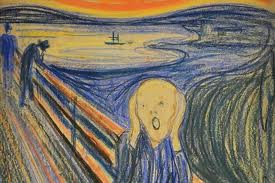
The Scream by Edvard Munch
I had some astonishing shafts of self-knowledge from it… things I was entirely unconscious of whilst writing it. I was trying to see what I could learn from it, though I admit I meant initially to pick out a passage which might help in my current novel.
But then the ms had to be put away in the bottom drawer of the filing cabinet again – I could bear only so much of delving into the past like that!
Anyone reading an old journal, or looking through old photos, might feel the same.
The sometimes unwelcome light of self-knowledge, in extreme cases, may make us feel like the tormented figure in the famous painting “The Scream” by Edvard Munch.
“The Scream” is uncomfortable viewing. Through his art, Munch’s fascination with self-image, and obsessive self-expression are themes that still resonate today.
It occurred to me, that humans desire more than anything else, “to be known”. The current passion “to become a celebrity” and for social networking are just two of the many contemporary phenomena that express this.
But we can bear only so much knowledge – either of ourselves, or of others.
As I read in a recent article on “The Scream” from the London Institute of Contemporary Christianity, we seek “an identity that gives us a unique sense of belonging and a connection to others. Knowing this, in modern life, truly sets us free.”
When I was a little girl, my friend Alison and I created imaginary worlds.A map of the imaginary world “Coneland” created by Alison & Sheila as children
One of these was the land we named “Coneland”. We wrote stories about the royal family of this land; at the bottom righthand corner of the map is the palace and the royal park, situated of course in the capital city, Coneington.
Alison is now a gifted textile artist who regularly exhibits her work in London and throughout the UK. Early expressions of her creative imagination may be seen in the worlds we designed before the age of 10.
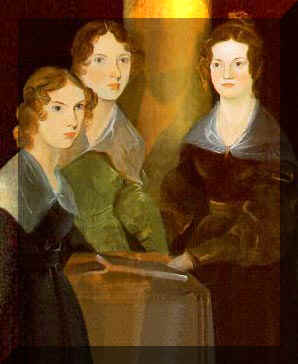
Among the most famous examples of imaginary childhood worlds is that composed by the Bronte sisters, “Gondal”. Emily and Charlotte and their siblings actively worked on the complicated fantasy world of “Gondal” for 16 years, and some of their creations at this time may be seen in the Bronte Museum at Howarth in Yorkshire.Painting of the Bronte sisters by Branwell Bronte
Of course, the artist Grayson Perry is well known for his childhood teddy bear Alan Measles, who was “the dictator and god of the imaginary world” in which Grayson Perry dwelt throughout his childhood (and of course well into his adulthood!)
In 1979 an author called Robert Silvey wrote a letter to “The Author”, a journal published by the Society of Authors, in which he invited contact from anyone who had created imaginary worlds in their childhood. He was gathering material for a book which was to be An Enquiry into the Imaginative Worlds of Childhood.
Alison and I sent off copies of our material; pictures and maps, a description of our imaginary world, the land of “Coneland” and its inhabitants.
This is an extract from Robert Silvey’s reply:
“It’s so interesting having two perspectives on this same ‘paracosm‘ (as we call it). The first thing that struck me about the map of Coneland was the similarity of the outline to that of the New Hiniwan States of which I was for some years the President. I suspect that this similarity has something to do with the dimensions of foolscap paper!”
Sadly, Robert Silvey died before completing the book.
But it remains true, as he said in his original letter to “The Author” magazine, that “had it not been for the subsequent fame of the Bronte sisters, no one would ever have heard of Gondal or Angria. Yet they were not the first, not will they be the last, children whose fantasy-life takes the form of an imaginary world.”
Did you ever create imaginary worlds during your childhood? And how has that influenced your adult life and vocation? If so, I’d love to hear from you!
Who’d have thought there’s a connection between emigrating to a far country, and being snatched by one of Doctor Who’s greatest foes: the Weeping Angels?
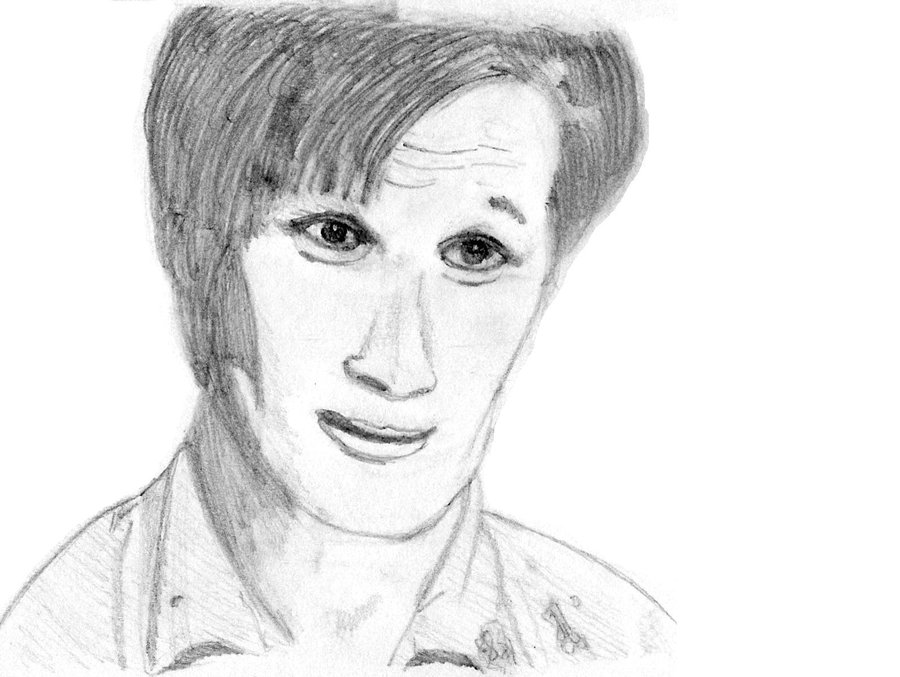
But I believe there is. “I’m the doctor” by MagicMoonCat on Deviant Art
The Weeping Angels played a vital role in the plot of the latest Doctor Who Episode, “The Angels Take Manhattan”, during which we, and the Doctor (played by Matt Smith),said goodbye to two beloved characters, Amy and Rory, played by Arthur Darvill and Karen Gillan.
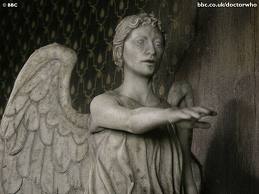
And I believe the reason why the Weeping Angels grip us is because they concentrate two of our greatest fears: Being Snatched Away, and Being Left Behind. weeping angel
Even when a family member who emigrated to a far country comes back home to visit England, it’s never the same.
The reason why is this: the time she spends here is Special Time.
And the time which the Weeping Angels snatch is OrdinaryTime.
Ordinary Time, Now, which can never be regained.
I lived and worked in Australia for four and a half years before returning to live in the UK. And during the time I was there I had a strange feeling, that I was existing in some kind of afterlife, in “the spirit world” – and that life back in England was “life on earth”.
I mention this because I think it feeds in to what I’m saying about the Weeping Angels, and the haunting power of what they do, and why the idea of them has such a grip on the imaginations of millions who watch Doctor Who.
The Weeping Angels snatch you away from your ordinary time, now, and steal all the energy you would have used to live in that time – and they transport you back to some period in the past.
I can imagine the creator of the Weeping Angels, Steven Moffat, standing in a churchyard or cemetary perhaps, and thinking about people who are snatched away.
Then he would have looked at a statue of a weeping angel, and thought: What if it dropped its hands and looked at me, and our gaze met? And that was all that was needed for me to be snatched away?
In fact, the story he tells is that he stood before a shackled gate, through which he could see a weeping angel statue in a graveyard.
And he still can’t understand why his idea touched so many people so deeply.
In moments like that, in the unconscious, far-reaching ideas are born.
“You don’t have to have everything together to make a difference to people’s lives. You just have to share your brokenness.”
So says Rob Parsons, author, public speaker, and founder of the charity Care For the Family.Rob Parsons OBE (credit quotestemple.com)
“Most people don’t want answers,” says Rob. “They can find their own answers. They just want to know they’re not alone.”
Care For the Family is a national charity which aims to promote strong family life and to help those who face family difficulties. And of all the charities I support, this is the one charity where, when you receive letters whose ultimate purpose is to ask you for more money, the letters are always worth reading for their own sake – even if you are most definitely not in a mood to be asked for more money. Rob’s letters are always funny, touching, moving. His letters are a gift in themselves.
The son of a Royal Mail postman and an office cleaner, Rob says that when he received his OBE from the Queen he thought of saying, “My dad used to deliver letters for you.”
Rob is a perfect example of someone who has built his success on vulnerability. Over the years he has shared many of the joys and sorrows of his own family life; the mortification, the pain, the insecurity, the sense of failure. I feel I know his wife Diane, and his son Lloyd and daughter Katie almost as well as Rob himself. The stories he shares often amaze me; they always touch a nerve of truth. I trust that he shares nothing without permission! And all I can say of Lloyd is that if I were to meet him in person, I would think, Your reputation precedes you, Lloyd.
I have been listening to Rob, and reading his books, for several years now. When I first heard him speak my children were young. When he spoke about teenagers, I thought, “Oh, I don’t have to worry about this teenage stuff – that’s years away.”
Now, however, I listen to Rob talking about teenagers, as I did last Tuesday evening in Birmingham, and think, “Yes. This is true. I have said those things. I do those things. That is what happens. That is what they do. That is how I feel about it.”
Rob says he built Care for the Family on vulnerability. “That is part of my story.”
On several occasions over the last few months I have commented on blogs or responded to online posts or newspaper articles by referring back to Rob Parsons, and what I have heard him say, and what I have read in his books.
This is because the same issue comes up again and again. Either people feel they never knew their father well when they were growing up; or fathers wish they had spent more time with their children when they were young.
On each occasion I have referred to Rob Parsons, and what he says about fathers. The important thing is to spend ordinary time with your children, he says. That is the time that really counts. Not the time you spend with them on expensive holidays you took them on because you worked “all the hours God sends” all year and often into the evenings and Saturdays, earning money to pay for the expensive holiday.
That expensive holiday will evaporate. Just being there, in ordinary time. So that you are around to listen, and to understand, and to chat, and to know things about your children. That is the most important message to all fathers.
Rob trained as a lawyer, but he then became a public speaker and writer. He could well be a stand-up comic – but to that gift he adds poignancy, sadness, and ultimately a powerful spiritual message.
Rob is a man who inspires, moves, and warns.
I commend him to you. If you haven’t read any of his books, please do.
On a recent visit to the Harry Potter tour at the Warner Brothers Studios in Leavesden, I was moved.The door to the Chamber of Secrets
Not simply by the moment when I and my two children first stepped into the Hogwarts Great Hall, or by the moment when I first came upon the model of Hogwarts Castle, or when I first saw that beautiful Hogwarts Bridge out in the middle of the “Back Lot”, or by when I tasted my first Butterbeer, but by the whole experience, and the reflections that arose from it.Hogwarts Bridge
All these wonderful objects and scenes and lovingly created details and the magnificent model castle… all because of one woman’s imagination.
To see the products of J.K. Rowlings’ imagination brought into richly-detailed reality was awesome.
I thought, All this is here because of people loving her stories in their millions.
“People in their millions”, of course equals “money”, in the film industry.Dolores Umbridge’s study
But I was reminded of what J.K. Rowling said when asked in Trafalgar Square after the premier of the final “Harry Potter and the Deathly Hallows” film, “What do you want to say?”
And she said, “Thank you – for making this happen.”
And as I left the Warner Brothers studios I thought too of her words, displayed in the exhibition: “Stories can only live if someone listens.”
On a recent visit to the Churchill War Rooms in London, I experienced in my imagination what it would have been like to work as part of Winston Churchill’s team underground during the Second World War.
As I walked through the offices and passed the displays and spent time in the Churchill Museum, I was particularly struck by the meaning of the words Cometh the hour, cometh the man.
These facts stood out for me afresh:
1) If Winston Churchill had died a few years earlier he’d have been a brilliant failure.
2) He entered office as Prime Minister at the age of 65.
3) His inspirational speeches made a profound impact on the outcome of the Second World War by raising the morale of the nation.
4) He was a difficult man personally, yet he inspired admiration and loyalty and devotion in all who worked for him.
5) We owe our freedom to him.
6) Times were uncomfortable and hard and restricted, yet people accepted it.
7) His speeches move us even now, and we can apply them to our lives even 67 years after WW II ended.
Another thing that shone out was the personal account of Churchill’s secretary – she described what it was like to type out his letters as he dictated them to her.
As someone who has had experience of numerous bosses in this kind of office situation, I thought to myself, He sounds like a nightmare boss. I’d have hated working for him!
And yet those who worked for him had only admiration, devotion and loyalty. One of the comments his secretary made was especially meaningful: “Sometimes what he was saying was so interesting, I would forget to type.”
I would recommend a visit to the Churchill War Rooms to anyone visiting London. It is a profoundly moving experience, which should make you look at your own daily life, and even your place in history, and in this world, with new eyes.