Picture this. A 22-year old actress who has won an Oscar, is asked at her press conference: “You’re awfully young to have so much success so far. Do you feel it’s a good thing? You’re not worried about peaking too soon?”
Jennifer Lawrence, winner of best actress award at 2013 Oscars (photo credit CalgaryHerald)
What can she do, but smile, give a baffled grimace and say, “Well, now I am.”
Fortunately, this did bring much laughter, as did her answers to other questions. When I watched this, I thought Jennifer may well have wished she was being questioned by Caesar Flickerman instead.
But this enquiry to the actress who played Katniss in The Hunger Gamesand has now won as Oscar for her performance in Silver Linings Playbook led me on to these reflections:
How can a young person ever feel they’ve ‘peaked too soon’?
What is she to say? “Oh yes. I’m terrified I’m going to suffer burnout at 30.”
For Jennifer Lawrence, as with any talented, creative young person in a similar position, the recognition she has already received is simply something that has happened to her, which is good, and which she receives with pleasure.
“Peaking too early” and “burnout” are concepts only people with decades of experience in this life can ever grasp.
What could be worse than losing someone you love through untimely death?
Poster for The Lovely Bones movie
And what could be even worse than that?
Losing them through murder.
And then worse than that?
Just imagine – the person you love, who is murdered, is a child, with all life and hope ahead of them.
This is the nightmare scenario for many parents.
And I would share those feelings absolutely. For this reason, when I first read about Alice Sebold’s novel The Lovely Bones it immediately struck me as a novel to avoid reading.
Why, you may ask? The reason was because my teenage daughter wanted to see it. She’d seen a trailer and found it appealing; she likes the young star of the movie, actress Saoirse Ronan; and her friend had recommended her to see it.
So I added it to my “LoveFilm” list and it duly arrived a few days ago.
The Lovely Bones by Alice Sebold was a book which has elicited very mixed responses. Although we are told “it received much critical praise and became an instant bestseller” on its publication in 2002, nevertheless I have spoken to people who have described it as “depressing”.
A young girl is raped and murdered by a serial killer and watches her family fall apart, from limbo.
From my point of view, as a romantic suspense author, I thought this a painful and difficult subject to handle in a novel.
Yet upon watching the movie I was totally captivated. The delicacy and beauty and wisdom with which the subject was handled reversed all my expectations.
Without reading the novel, I had thought the premise of the story essentially flawed. Firstly, telling people in this situation to ‘move on’ for its own sake, seems specious. Evidence tells us that in such cases victims above all desire justice – and until they have seen justice to be done, they cannot ‘move on’.
Secondly, to my mind, telling the story from the viewpoint of a murdered child in limbo, seemed to me a device that changes the subject in an artificial way right from the beginning. In this life, any such tragedy would be instantly rendered less agonizing if you knew for sure the lost person was in fact very close to you, present with you, and also in heaven. And of course the idea of wandering around in “limbo” as part of the post-death spiritual journey, is derived from Catholic tradition, and one of the explanations popularly given for ghosts.
I believe that in real life we never do have such immediate and uncontrovertible assurance – with or without religious faith.
So I thought it a very dubious quasi-spiritual approach to such a theme. And yet, in the hands of a skilled director – in this case, Peter Jackson – a book can be turned into a movie where these difficulties recede, and another message comes through.
In some respects, the subject invites comparison with the book The Shack.
In this book, too, a young girl is lured to a ‘killing place’ and murdered. The story follows the reaction of Missy’s father to this tragedy, and moves on into an exploration of God which, I dare to believe, hs the power to transform our habitual attitudes.
I felt that in each story a device of separation is used: defamiliarisation. It seems that some of the worst experiences in life can only be truly understood from a distance. This has long formed part of the genres of mystery and imagination.
This was well underscored by the music – slow, languorous and dreamlike behind the “In-between world” and edgy clanging discordant notes as the murderer starts to saw wood and construct his next killing den. The visual effects too were very powerful; shadows moving across rays of light “in the blue horizon between heaven and earth” like images in dreams, and the creepy dismal gloom of the world of grief which the family inhabit, with the father’s initial denial and continuous refusal to let go. Very striking too was the silence behind the murderer as the blackness slides aside to reveal him sitting in his house.
The words “I knew then even though he loved me he had to let me go ” restate the theme, as do the words, “I begin to see thing in a way that let me hold the world without me in it.”
Have you seen the movie? Do you believe that a flawed premise in a novel can be transformed by a movie director? Please share your own thoughts, on this, or on the issues it raises.
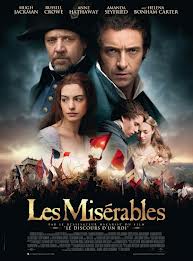
How is it that the story of Les Miserables has tapped into the emotions of so many?
Les Miserables movie 2012
I first read Victor Hugo’s novel in my late teens/early twenties, and a central idea stayed with me over the years (though not necessarily in the exact words Victor Hugo used):
You have been taken away from evil, and been given back to God.
When questioned, often even the actors and actresses in the movie cannot necessarily explain why Les Miserables has such power. This may of course be because they’re so close to the story. Ann Hathaway was a recent example. When asked this question, all she could reply was, “I don’t know. It’s just a great story.”
But I’m fascinated by what lies behind this: for Les Miserables is an intensely religous story. And this is a society in which the majority of people would not describe themselves as ‘religious’ (if collectors of statistics are to be believed). And so this begs another question: Why is the opinion I quote below such an uncommon one?
The authors have pared down Victor Hugo’s great wallow of a novel to its dumb, pious moral (Christian forgiveness always wins, though you might not live to break out the champagne).
I would dare to believe that the majority of the 60+ million people who’ve seen Les Miserables as a musical over the past 3 decades do not agree with him.
I believe that part of the success of Les Miserables is due to the fact that it has many hot story moments.
And these are bound up with the archetypal themes of the story, redemption, forgiveness and unconditional love.
As a romantic suspense author, I know only too well how vital these hot story moments are.
For me, the most emotional moment in the movie was when Cosette (played by Amanda Seyfried) sings, “Papa, you are going to live.”
Superficially, this is just a young girl who refuses to believe she is about to lose the dying man in front of her. And for Valjean, this must be his supreme moment when he is given a sense of belonging.
But the power of these words, for me, works on another level; as does most of the movie. Cosette is re-stating the theme; the theme of eternal life through spiritual redemption.
In creative writing, we cannot afford to ignore the different levels on which a story moment may work. For me, our ability to do this is a matter of both mystery and imagination.
Although the characters of Les Miserables are in extreme, unjust circumstances, their emotions are, I believe, emotions many of us share on the spiritual journey.
Though you might not dare to believe your own deprivations compare with those of Valjean, Fantine and Cosette, being minor by comparison, we do feel the same.
Over the course of this life, at different times, we too may feel the same wretchedness as Fantine, the same self-doubt and guilt as Valjean, the same obsessiveness as Javert, the same grasping small-mindedness as the Innkeeper and his wife.
I believe that we’d feel the same if we were also visited with a great act of grace; and especially if we were in Jean Valjean’s position, and heard these words: “My brother you no longer belong to evil. With this silver, I have bought your soul. I’ve ransomed you from fear and hatred, and now I give you back to God.” (words the Bishop speaks to Valjean after he has given him the silver Valjean tried to steal). When I read the Bishop’s words to Valjean in Victor Hugo’s novel, for me they had the power of a blessing, one which would stand by you throughout your life – as of course they did for Valjean in the story.
Over the past 3 decades Les Miserables has been seen by more than 60 million people in more than 40 countries and in more than 20 different languages.
I believe that Les Miserables shows that many more people respond to themes of spiritual redemption and forgiveness and unconditional love, than would ever call themselves ‘religious’.
These are archetypal themes, and they are written on our hearts.
What do you think? Please share your thoughts in the comments!
Who’s the most compelling character in a Spiderman movie?
Rhys Ifans as Dr Curt Connors
For me, it’s Dr Otto Octavius (Doc Ock) and Dr Curt Connors.
As I watched “The Amazing Spiderman” DVD again the other day, it was Rhys Ifans in the role of Dr Curt Connors, that my eyes were on. Rhys Ifans is an actor I love from his numerous movie roles, including that of Hugh Grant’s Welsh flatmate in Notting Hill, and Luna Lovegood’s father in the Harry Potter movies.
This was such a different role – with a pleasant, understated manner, he was just a low-key, decent man… until he was driven to extremes by the pressure of circumstances and by the threatened destruction of his dreams.
Ordinary we may be, but I believe we can relate to that!
We’re engaged by the transformation of ordinary, nice, reasonable human beings, into rapacious killers.
Alfred Molina as Doc Ock in “Spiderman 2” was not only horrific, but moving and poignant. Even more so, because, in his monstrous octopus form, he still had his own, recognisable face: the same face he wore when he gave up his time to chat kindly to Peter Parker, giving him a sense of belonging. A similar idea was used in the Doctor Who episode about The Lazarus Experiment, when we saw Mark Gatiss’s face recognisable in the alien monster.
Dr Curt Connors in the process of changing into a giant lizard
What is it that makes people change, in this life?
I look at this here, in a blog post about people being elemental.
Books, TV drama and movies, and of course, creative writing, are all safe places for us to explore our dark side.
I explore this trope in my novel Mystical Circles. Although I’m a romantic suspense author, my own Other Side – exploring strange spiritual and psychological alleys in characters – is always there.
And if, after a lifetime of struggle, our dreams were to be utterly destroyed, I believe that many of us may fantasize about going on a rampage, expressing all our darkest emotions. This may come out through images in our dreams. Of course, the checks and balances present in the psyches of most of us, prevent this happening in reality. And so it stays in the world of mystery and imagination.
Would you dare to believe that, on the spiritual journey, alongside our capacity to evolve and improve and be redeemed, there might run another, dark strain: that our nice and reasonable selves might be changed into monsters?
A nationwide choral singing boom is giving fresh meaning to the sound of music, with new choirs popping up at the fastest rate in decades.
Increasing numbers of people are starting their own vocal groups, inspired by the nation’s new choirmaster-in-chief Gareth Malone, …. because they want to boost their wellbeing, mental or physical.
I’ve sung in choirs since I was very young. I was first introduced to it by my father, a great choral singer himself – he held high-value currency, as a tenor.
I sing in a number of different groups, and I love singing! But, even with all that experience, I would still love to sing under the direction of Gareth Malone! Perhaps one day I’ll achieve that wish!
Personally, I can’t get enough of singing! So now I’ve also joined a local Community Choir in Leamington Spa called “Songlines”.
“Songlines” is one of many community choirs. They’re all linked into the Natural Voice Network.
In a “community choir”, the singers stand in a circle, without having to follow printed music, and the leader is at the centre, teaching the lines of music by singing them, and the choir members pick up the music from this. The lines of music seem very easy to sing, you master them quickly, then the fun comes when the leader directs you to sing it, perhaps, as a round, accompanied by movement. He may divide the choir into 4-8 groups and get each group to stagger their entries.
The sound of the voices blending is magical. And this – with the right direction – is really very easily achieved.
The Guardian article above refers to “wellbeing, mental or physical”. To that I want to add “spiritual wellbeing”.
Many different spiritual traditions have recognised this, and make full use of it.
Bliss through sound, using the human voice, is part of the Buddhist and the Yoga traditions. Years ago I went to the Buddhist Centre in Bethnal Green, East London. There I joined weekly sessions of Buddhist chanting: an experience of joy and deep peace.
The Yoga tradition, too, has fully understood the healing power of sound, incorporating yogic humming and chanting into their practice.
Taize prayer , in the Christian tradition, also uses beautiful harmony singing, to achieve a similar sense of upliftment, and connection with God. I do this, too, every month, at St Peter’s Catholic Church Centre in Leamington Spa.
Of course few experiences of body, mind and spirit can equal that of singing with a large choral society in Bach’s B Minor Mass – and, indeed, any other major choral work. Being part of this grand swell of sound can lift you right out of this world.
So I celebrate Gareth Malone for spreading wide the love of choral singing and the knowledge that we can all sing – whether or not we currently believe so.
What about you? Do you believe you “can’t sing?” Has Gareth Malone encouraged you to believe otherwise – or perhaps to join a singing group yourself? Or maybe you’ve already experienced joy through singing in a group, large or small? Have you been inspired by the work of Gareth Malone? Let me know your experiences – I’d love to hear them!
You may enjoy these other posts by SC Skillman Blog on the subject of singing:
In our British culture there are a number of different touchstones of our national identity – and here’s one of them.
M & S.
This is not so removed from the subject of my fiction – as I believe that Marks & Spencer has something to say to us about being British, and about the British Class System.
Britain does still have a recognisable class system – more so than many other countries, I would suggest – although it can be argued this is now breaking down.
M&S have over the years skilfully exploited this aspect of our society, across the socio-economic range. It has maintained its reputation for excellent items at bargain prices right through to the highest quality goods. Many of the stores’ products of course have universal appeal, for example, food and wine. Additionally, however, with the fashion selections, beauty products, and nightwear, I feel that M & S represent a strong appeal across a socio-economic range , from “low cost good value” right through to “very stylish, above average cost, high quality.” All this is to do with Reputation and plays into the English class system in a very interesting way.
When I was a young child, going into M&S with my mother was the worst experience I could think of, the ultimate in boredom. Now, as I think back, I wonder whether it was the pristine, controlled, organised, spaciousness of it. Perhaps if it had been more chaotic or sumptuous or bohemian I might have coped better!
And yet when I consider M&S now, it’s a very different experience for me!
I think of M&S as quintessentially British, and I was particularly conscious of this when I lived in Australia. On my first return home to England from Australia, a visit to M&S in Marble Arch, London W1, gave me a feeling of reclaiming my English identity. I bought a beautiful black lace skirt which still has pride of place in my wardrobe.
Offering us “shopping experiences” is big business in today’s consumer society; it’s not just the products you buy, but the whole experience. Many do love going to large stores or giant malls; others might prefer the small shop – and there are very special cases where the small shop with its personal service is something we long for – but somehow, M&S have skilfully responded to this by downplaying their large-scale commercial nature in order to provide a comfortable and familiar feeling, evoking a strong sense of English “belonging”.
Of course, none of these things would I have appreciated as a child. And I must admit that even now, when I’m scanning the reasonably-priced-but-still-good-quality T shirts, when I see the children hanging around waiting for their mothers to make a choice, I feel empathy with them!
Because, over the years I’ve read many books on the Holocaust and by survivors and by survivors’ children. I’ve listened to their stories, and I’ve engaged emotionally with those stories.
The first book on the subject which I ever read was a novel, “The Last of the Just” by Andre Schwartz-Bart. I remember, before I read that book (at the age of about 14), all I knew of the Holocaust was a vague knowledge gleaned from school history lessons. I must have mentally “sanitised” the information I received, because I’d somehow got hold of the idea that only adults were killed, and that all babies and children were saved.
When I read “The Last of the Just”, I began to understand.
My journey of understanding has taken me through movies, TV programmes, books…
As the generations pass, there’s an ever-present temptation to put the Holocaust into the bin of “horrible things people have done to each other in the past” and to somehow shift off the responsibility to use it for self-examination.
This is why I believe that would be so dangerous: because the Holocaust gives us insights into our own nature as human beings: an inescapable truth that we all live with, in every generation.
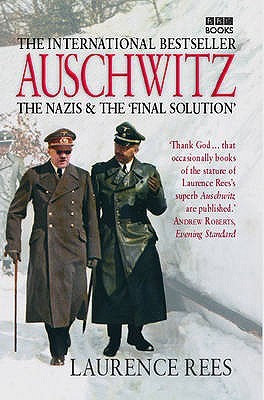
The most compelling book I’ve ever read on this subject is “Auschwitz: The Nazis and The ‘Final Solution'” by Laurence Rees (judged to be History Book of the Year in the British Book Awards 2006). The book was developed from a television series Rees wrote and produced.
Laurence Rees concludes with these words:
We must judge behaviour by the context of the times. And judged by the context of mid-twentieth-century, sophisticated European culture, Auschwitz and the Nazis’ ‘Final Solution’ represent the lowest act in all history….. Once allowed into the world, knowledge of what the Nazis did must not be unlearnt. It lies there – ugly, inert, waiting to be rediscovered by each new generation.
For the TV series and the book, Rees gathered testimonies from bystanders, perpetrators and victims, including revealing interviews with SS men and sundry European Fascists. It’s in this broad range of testimonies that Rees offers us a profound insight into human nature.
On page 261, Rees considers why so many went along with the horrors of the regime, and speculates that human nature is “elemental” – the realisation came in the camps that human beings resemble elements that are changeable according to temperature. Just as water exists as water only within a certain temperature range and is steam or ice in others, so human beings can become different people according to extremes of circumstance.
Rees makes the point that this is more than just the seemingly banal comment that human beings alter their behaviour according to circumstance… it is less a change in behaviour… and more a change in essential character.
His presentation of this led me to examine my own thoughts on the subject, in relation to my experience of life.
Over the years, the Holocaust has stood for me as the benchmark of pure evil, and Anti-Life.
But the other aspect of the Holocaust which particularly interests me, as a Christian, is the recurrent miracle of faith in God.
It has long been a source of great wonderment and awe for me, that there are those (not all, of course, by any means) who were caught up in, came through, and were subsequently affected by the Holocaust, who have not only held onto but have renewed and strengthened their faith in that loving and sovereign God.
When we consider the people drowned in that vast tidal wave of suffering, we may feel overwhelmed and ask What can we do? How should we respond?
The answer they themselves gave, when they were able to, was, “When the War is over, tell our story to others.”
What they most wanted was that their stories should be told.
What we then choose to do with the knowledge these stories give us, is another matter: it may profoundly affect our future lives, on every level: or of course, it may not – according to what we choose to do with that knowledge.
But from my own standpoint as a novelist, I believe this is the first essential: let us keep listening to, and hearing, and engaging with, their stories, as they wished. To me, that is our duty to those who suffered, and the least we can do as fellow human beings.
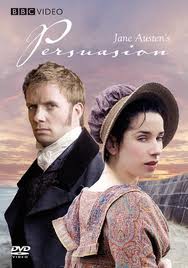
Jane Austen’s Persuasion, which gave Tom Di Giovanni the idea for his novel
Q – What is the core of a successful novel?
A – You can in some way identify with it; you recognise it as relating to your own life experience.
And this doesn’t mean you need to have experienced exactly the same events that the novel describes: simply thatyou recognise the truth in the story from your own life.
And that goes for all genres, even fantasy or escapist fiction. Somewhere in the structure of that story you recognise Truth.
Such is Tom Di Giovanni’s debut novel “Home”.
I first met Tom at our Church (St Mark’s in Leamington Spa) where he plays guitar and occasionally leads the music group. His love of music and in particular the guitar is demonstrated in this novel.
Tom wrote “Home” during National Novel Writing Month 2007, then worked on it in between the demands of a full time job.
Edited by Tom’s father (editor, translator and author Norman Thomas Di Giovanni), the novel has now been issued in a limited edition of 35 for the author’s family and friends. I was privileged to receive a copy, and I’ve now read it.
In simple, graceful, lucid prose, Tom tells a touching story with which many would identify, a story that shows how life offers second chances, with an essentially optimistic message, that affirms we can make the right choice when life gives us a second chance.
Tom took the novel “Persuasion” and based his story on Jane Austen’s – taking it from the male point of view.
The Dell , a small, hidden valley in Leamington Spa where author Tom Di Giovanni saw a girl sitting alone playing the guitar, which gave him inspiration for his novel
28-year-old Martin, an architect, returns to his home town (in England’s West Country) and meets again the girl who broke off their relationship 10 years before. Daisy was persuaded by friends to reject him for being younger than her. But Martin then meets 17-year-old Claire, a talented young singer-songwriter, who has a job in the local guitar shop. Tom’s description of their unfolding relationship is drawn with subtlety and a sure and delicate touch.
Though Tom set the novel in a West Country town he used elements of our own local town Leamington Spa. In particular one scene is set in “The Dell”, a local park, where he saw a girl sitting alone playing the guitar, which inspired him for his novel.
When I read the novel I felt I was reading something that was:
1. Well crafted;
2) Had a water-tight structure;
3) Had integrity in and of itself;
4) Pointed me to a universal truth I could verify from my own experience.
They say a book must have “wow!” factor to succeed. The “wow” factor of this novel lay in its power to move, its scrupulous attention to detail, and its truthfulness.
The message of the novel is:
That which you believed lost, you can later return to and find again: but only if you meet the challenges the new situation sets; and only if you apply the new insights and discernment you have gained in the intervening years. You will be tested again, and past issues may arise once more in a new disguise.
Tom hopes to find a publisher soon to take on the novel. So watch out for him!
Frankie Howerd my all-time favourite comedian (source: Channel4.com)
Frankie Howerd is my all-time favourite comedian.
In my recent “Next Big Thing” blog I noted that, as an author, I owe part of my inspiration to characters I’ve loved on TV and movies.
Frankie Howerd is up there with the greatest.
I think of him now with love and admiration. He shines out in the world of popular entertainment.
To me, his comic personna represented the archetypal underdog, which the British love. His success during his time as one of our most-loved entertainers was probably due in large part to the English Class System.
Frankie Howerd, I felt, was “the common man” speaking to you one-to-one about what you and he truly feel about all those who have far grreater pretensions to sophistication, intellect,wealth or status.
The Channel 4 programme noted that his most outstanding quality was connection with the audience. People loved him through his shambolic delivery, through “the hotch potch that he was”.
During my childhood & young teenage years he was for me a source of great delight. Before I saw the recent Channel 4 programme, I hadn’t previously realised he was closely involved with the Beatles during their early days and even filmed a scene with them for the film Help, which ended up on the cutting room floor.
I longed to see that scene again but it seems it was destroyed.
I remember him coming on in the Royal Variety Performance at the London Palladium and his first words were “Thank you for waiting for me.”
And that was exactly what we had been doing. Waiting for Frankie Howerd to come on.
There was no feeling of egotism about it. It had the quality of Frankie meeting up with you at a time which you and he had arranged. As if you were friends, just keeping an appointment to meet up.
Frankie’s most famous sayings: “Titter ye not” and “No. It’s wrong to mock the afflicted” and “Please yourselves” stand out in my memory: the hilarity was all in the delivery and the context and the personna Frankie offered. “I only do this for the money” and “What d’you expect, with they money they give us?”
Frankie was the comedian of whom we would say, “We must see it! Frankie Howerd is in it!”
Unforgettable, too, was his use of his own full name, “Francis”, to denote some kind of appeal to a more serious, higher status self, one with more gravitas.
He was the actor Aristophanes, the ancient Greek comedy writer, would have loved for his plays.
My family adored Frankie’s ice cream commercial on TV when he’d claim he was only doing it for the money, try the ice cream and then says, “Oooohh! It’s not bad after all!”
The Channel 4 programme revealed the anxieties behind his performance, and how much he depended on his devoted partner, Dennis. I believe, too, that Frankie’s style of lewd, effete, lecherous humour as exemplified in the TV sitcom series “Up Pompeii” in which he shone out as the slave who never got to the end of his Prologue, is something only gay men truly excel at.
Frankie Howerd died on 19 April 1992 and just before he died, in his last public appearance, he spoke to an audience of students in the Oxford Union saying, “I’m not what you would call an intellectual… brainy… a clever clogs,” delighting the Oxford students.
And as I write about him now, I remember that immortal line he spoke to the Roman Centurion near the end of the “Up Pompeii” movie: “Oh, and by the way, you owe me a cucumber.”
Do you have a favourite comic entertainer of all time? I’d love to hear your own choice!












 scskillman.com