Places of Inspiration Part 2: The Heavenly City: A View of London

London View
A poster of famous London landmarks (1989 Christopher Rogers)

What is your view of the city? Is it a place you work in, and suffer all the stress of commuting? Or perhaps it’s a place you live in? In my novel Zoe emails her sister with these words: Hi, you in crowded, stressed old London from me in the peaceful, perfect Cotswolds… But those words reflect only one biased view of the city; and this isn’t my own view of London, living, as I now do, 98 miles away from it.

I was  born and brought up in south London (Orpington in the borough of Bromley) and so London was a big part of my life as a child and a teenager. When I returned from university I moved to live in Bayswater, London W2, with my sister, & continued to live there for seven years. After that I moved away. But last year I decided to visit for an extended periods and visit many London attractions I hadn’t been to for a long time. And those two weeks fed my reflections upon why the image of a great city is so powerful for religious and spiritual writers.

Dr Johnson said, When a man is tired of London, he is tired of life.  And certainly, London, with its rich history, cultural depth and vibrant life, is a source of inspiration to me.

In the Bible, we find the writer to the Hebrews saying this:For he looked for a city which hath foundations, whose builder and maker is God (Hebrews 11: 10)

The heavenly city is a city with everlasting foundations.  And a great city feeds us body, mind and spirit. From the BODY – the Tower of London – through the MIND – The Violent Universe show and the discoveries of Einstein at the Royal Observatory, Greenwich, to the SPIRIT – the Whispering Gallery and Holman Hunt’s painting The Light of the World at St Paul’s Cathedral, I was inspired, informed, amused, shocked, amazed, touched, and filled with wonder.

Living as I do in Warwickshire, I’m fortunate to have all the treasures of this great city so accessible, via the rail network (not that it’s that difficult to get to London from any major railway station in the UK!)  And in many ways, the life of London is encapsulated by the story of the Thames. As Edmund Spenser said in his poem ‘Prothalamion’,   Sweet Thames! run softly, till I end my song.

 While looking round the exhibition in the Thames Barrier Information Centre at Woolwich, I felt moved by the human imagination, ingenuity and skill which has worked together to tame the power of the river for the protection of a city and its people. One of my own forbears was a Thames Waterman (as evidenced from a 19th century marriage certificate.)  See My Family Background page in my website. My early life was strongly associated with the Thames; the toolmerchant’s business A.D. Skillman & Sons which my grandfather started in 1901 opposite the Woolwich Ferry traded for over 100 years until my brother, who inherited it, finally had to close down in 2002. I remember being sent off to cross the Thames on the ferry to North Woolwich and back again on my own when I was about ten years old, and how much of an adventure it was for me.

 But what of that other river – the river of life flowing through the holy city, Jerusalem – a powerful symbol in the Bible?  We are told by the writer of Revelation that this river rises up from the throne of God and the Lamb and surges crystal-clear down the middle of the city street. On either side of the river grow the trees of life. This holy city is of pure gold transparent as glass, with a wall of diamond, and foundations faced with precious stones; and the 12 gates are 12 pearls. The city has no temple since God and the Lamb are themselves the temple; it does not need the sun or the moon for light as it is lit by the radiant glory of God.

 Why is this biblical image of heaven as a great city so powerful? I suggest it is because, here on earth, all the ingenuity, folly, genius, wickedness, nobility, inspiration, despair, joy and creativity of which we human beings are capable is encapsulated in a great city.  In heaven all will be made perfect. And here on earth, just as the city teems with life, so it will be in that holy city.  And that is why the image of holy city is so appropriate for heaven.

Places of Inspiration Part 1: Exotic Marigolds, Mystical Mountains and Memories of India

I recently watched The Best Exotic Marigold Hotel, and found it a movie full of insight, humour and hope.  I vividly recalled my own arrival at Delhi Airport several years ago for a visit to Northern India, and the noise, the brilliant jewel-like saris, the garlands of marigolds placed around our necks. The images flooded in on me:  colour, chaos, begging children, families camping and cooking in the middle of the central reservation in major roads in Delhi. I relived the shock of seeing leprous beggars, the pity I felt on meeting girls who appeared to be only about 10 years old, carrying tiny babies on their backs, holding out their hands for free offerings of food or money; the disease and poverty, and also the spirituality, the beauty and the profound joy of India.

In ‘the Land of the Gods’ the Garhwal Himalayas – I journeyed in a minibus up a perilous mountain road, our final destination being Badrinath, place of Hindu pilgrimage, just before the Tibetan border. The road was lined with signs saying things like “Yours Hurry is Another’s Worry”.  We reached the mountain village of Joshimath late in the afternoon. As I inhaled the fragrance of a syringa bush there, I realised a local resident stood beside me. He remarked: “the might of God is all around” in a very casual way, reflecting what I was thinking and feeling at the time. And I thought: This wouldn’t happen in England. And if it did it would have a very different cultural context!

Our journey ultimately led to Badrinath. We arrived as dusk fell and there before us was the peak of Neel Kanth, luminous in the full moon. It was a sight I would never forget.  Since then I’ve seen a number of images on Google of Neel Kanth, and yet none comes near capturing the impact this mystical mountain had on me that night as I arrived in Badrinath.

There too, on the mountain path above Badrinath, I met a Sadhu – India holy man who lived in a cave. See my recent post for a photo of this holy man, whose tranquil expression made a lasting impression on me.

So to sum up my reflections on India: there may be squalor, social injustice, and dysfunctional public services, but this is a country of extremes, and I felt a visit here should also have a profound spiritual impact, as it did for the characters in “The Best Exotic Marigold Hotel”, transforming the lives of each one of them, bringing all of them clarity and moments of radical decision.

This is a personal reflection on India, and I know there will be many visitors who feel differently about it. Have you visited India? And what are your thoughts on this country of extremes?

The Psyche of a Cat and Emily Bronte’s School Essay

Hattie in the garden - photo taken by Abigail Robinson
Hattie in the garden – photo taken by Abigail Robinson

Cats both domestic and wild have been worshipped, adored, feared, coveted, persecuted, psychoanalysed, parodied,  wondered over, painted, written about, sculpted, photographed… and there is no sign of this fascination ever abating.

Some of us find cats enchanting; others greatly prefer dogs. Personally, I love both; but admit that I’ve probably spent longer pondering the psyche of a cat, than that of a dog.

When considering the appeal of our own cat, Hattie, I believe that few come closer than Emily Bronte to explaining humankind’s long enthrallment by cats. 

Emily Bronte wrote a French essay called “The Cat” in 1842 – often one of the examples cited in demonstrating her unsentimental attitude towards nature. The cat, she wrote, although it differs in some physical points, is extremely like us in disposition. Then she considers the three charges of hypocrisy, cruelty and ingratitude levelled against the cat by its detractors : detestable vices in our race and equally odious in that of cats… a cat in its own interest sometimes hides its misanthropy under the guise of amiable gentleness… the ingratitude of cats is another name for penetration. They know how to value our favours at their true price, because they guess the motives that prompt us to grant them. 

Emily understood that we see something of ourselves in cats. We recognise their psyches. And of course we are free to interpret that as we like!

For instance, Hattie, among her many intriguing characteristics, never fails to miaow for her biscuits approximately one hour before they are due. And the miaows continue until we cannot possibly resist any longer.  The danger of course is that the biscuits come slightly earlier each day… Her persistence is admirable, and I have often compared it to the way I handle frustration in life. I have even thought that if Hattie had written a novel, and wished to find a literary agent to represent her, she would achieve success much quicker than many thousands of despairing authors of slushpile manuscripts. 

Our cat Hattie - photo by Abigail Robinson
Our cat Hattie – photo by Abigail Robinson

Emily Bronte wrote her cat essay under the tutelage of her French master in Brussels in 1842. Five years later she published Wuthering Heights. In this novel she created the kind of home, occupied as it is by a deeply dysfunctional family, where any cat would lead a high-risk existence –  escaping from the boot of sadistic Hindley when he’s in one of his rages, or the heartbroken revenge of a demented Heathcliffe a generation later. Emily’s perception of human nature is fierce, penetrating and unsentimental; and therein lies her reliability  in discerning the psyche of a cat.

What do you think? Is this a true picture of the cat? Or perhaps you disagree with Emily Bronte? I’d love to have your comments!

The Archetypal Appeal of the Vista

This slideshow requires JavaScript.

These are two images of the Syon Vista – one of the three great vistas in Kew Gardens which together form a triangle between Pagoda, Palm House and riverside viewpoint. And as I stood there a few days ago, I was reminded of why we love a long, straight vista. The vista, or avenue, draws the spectator forwards along it, to the central vanishing point. It represents our dearest wish: that life may be like that. And perhaps it may be – in our dreams. Instead, in reality, our lives twist and turn and diverge and backtrack. The path has many confusing cul-de-sacs. We fall down potholes. The path leads through marshy ground, and we nearly sink beneath the surface. The path may be a perilous mountain track, or it may be piled with jagged boulders.

But a grand vista is none of these things. Instead, it progresses smoothly into a secure, warm, welcoming future.  We find it comforting, reassuring, uplifiting. Avenues represent human control over the landscape, imposing order on a chaotic world. And since imposing control on the landscape is a major, expensive task, the grand avenue is the province of the wealthy and the powerful. Capability Brown  demonstrated his ability to create dreams from landscape – at a cost. His clients found the grand vista a perfect way to reassure themselves of their status.

Windsor Great Park boasts a vista – the Long Walk, first set out by Charles II. And as it was developed in time, it became an ideal route for ceremonial rides. George IV reaped the benefit of the vista, however, not merely by public display although he was indeed very fond of that. No – in addition he had between 20 and 30 miles of neatly planted avenues to ride along, from which the public was wholly excluded.

I suggest that a vista means many things to us – and foremost among them, hope, dreams, clarity, destiny, goals, the future, focus, direction, drive, ambition, vision. All those things we either long for, or are told we must have, or we aspire to.

On the straight vista through life there are no snakes, no ladders, no forks, no bogs, no potholes, no detours. The goal, our destiny, is always in sight; and we are always progressing smoothly towards it. Nevertheless, alongside our love of grand avenues and vistas, we also respond to great stories full of twists and turns. And the reason, I suspect, is that  both play their part in our understanding of life. Dreams and reality intermingle; the ideal and the real guide each other.

SC Skillman

Our Picture of Heaven – Static and Changeless, or Wild and Dynamic?

a sketch of heaven

What is your idea of heaven? If asked to draw an image of it, what would you come up with?  I’ve found that people may often be unwilling to either say exactly what they think heaven is like, or to create their own image of it. And then they seem held back by ideas of “eternal rest” or heaven as static and changeless – something we cannot relate to in this world at all.

Back in December last year, during a Quiet Day at my local retreat house, Offa House in Offchurch, Leamington Spa, we were invited by our leader, Revd. Ruth Tuschling, to “draw a picture of heaven”.  I went into the garden room – my favourite room in this retreat house, which has a tranquil, spiritual atmosphere – to find art materials laid out.  I took up oil pastels and watercolour paper and began to draw sweeping lines, not quite sure what they might reveal.

To me, heaven is not heaven if it is not dynamic and creative and vibrant. I’ve heard it said that heaven is a place where God “holds our lost dreams safe for us”. My dreams involve communicating, entertaining, captivating… a rushing wind would more closely represent them. Notice these are all verbs. They are all about activity, about “doing”. Is there no “doing” in heaven?

In the past I’ve thought of heaven as if it was a celestial version of Switzerland – snow-capped peaks, waterfalls, and alpine meadows bright with flowers. I’ve imagined glorious fragrances – pine, lemon, lavender, and have seen waves of golden gorse and purple heather, and heard the tumbling water of a mountain stream, birdsong, the music of the spheres… Further back, when I was younger, I visualised heaven as a reunion with my dog who had just died, Kimmings (a miniature silver poodle). He would come running to meet me, barking gladly, his tail wagging. But now, what image would I depict? Certainly not angels with harps on clouds. And dare I even make a representation that somehow limited this most inexpressible of subjects?

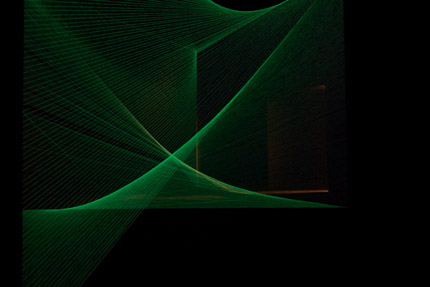
A Thin Line Between Space and Matter by Tamar Frank (photo by Sophie Mutevelian)

So instead, I began a sketch that, to my delight, I later found echoed by an art installation at the “Lost in Lace” exhibition at the Birmingham Art Gallery: “a thin line between space and matter“. I created something that conveyed, however obscurely, how I felt about being in heaven, what kind of experience it might be, in terms of sensation and consciousness. And when my curving lines had caught me up and swept me into the space at the centre, I added  a few words – any quotation at all that I could remembe, about heaven –  because, as a writer, I believe there must be words in heaven too, as words have given me as much joy as images.

Good Friday, The Magic of Believing, and Success and Failure

Once I tried to live by the magic of believing, in which positive thoughts always attract good circumstances into our lives – until I realised success and failure in this world cannot be understood in such a simplistic way. How straightforward life would be if that was so.

The truth is none of us know for sure to what we must attribute success or failure in life.  Some flourish in this world who by any moral law should not do so – including those dictators who hold onto power and wealth for many years by the sheer force of terror. And sometimes people can think positive thoughts, and it leads them on a path of suffering.  I think of the young girl at my daughter’s school who learned she had been diagnosed with leukaemia, smiled and said, “I’m lucky to have lived until now,” and then lived out the rest of her brief life with a sunny, cheerful, positive attitude.

I’m also reminded of the group of nuns who went out to El Salvador to offer care to the oppressed people, and all met violent deaths. Their story is told by Sheila Cassidy in her book Good Friday People.  Here she gives other examples, too, of people who set their faces towards suffering, just as Jesus “set his face towards” Jerusalem (where he would be arrested, tortured, tried in a kangaroo court, sentenced to death, and crucified).  

I write this on Good Friday, when we reflect upon Jesus whose love took him on a path of suffering. It  led to the Cross – in worldly terms the ultimate failure.  And yet  the true significance of Good Friday is the triumph of love over evil. We do not flinch from the Cross but dare to wait at the foot of it – not to wallow in shame and guilt (as some suppose) but to receive the grace, love and peace poured out freely for us. And when I think of that grace, love and peace, there at Golgotha, the darkest of places, I can see the Christian resonance in these words from J.R.R. Tolkien: “May it be a light to you in dark places, when all other lights go out.”

The Wailing Wall, Sacred Space and Topol

A recent 24/7 prayer weekend at church created a “sacred space” in a room, where people could come and reflect, and paint and write and draw, and meditate in a tent or tie a leaf to a tree or write their angst on a paper chain then break the chain and tear it to pieces and throw it away. But what struck me most was “The Wailing Wall”. Here people could post their anger and doubts and frustrations to God.

And what I discovered was the amount of anguish going on below the surface. “My yoke is easy and my burden is light,” said Jesus. If you’re a music lover you may have heard of these words in Handel’s Messiah. What Jesus says is: Let go of all your worries and anxieties and lay them on me. And in this lies the value of the Wailing Wall (as used in our 24/7 prayer weekend).

The Wailing Wall in Jerusalem  – the tradition of pouring out anguish to God – from the Lamentations of Jeremiah through to Topol in The Fiddler on the Roof is a powerful tradition.

 Come to me… Keep company with me and you’ll learn to live freely and lightly is how Eugene Petersen expresses Jesus’ words in his wonderful paraphrase of the Bible in streetwise language, The Message. Come unto me all ye who are burdened and heavy laden and I will give you rest.

An Artist’s Feeling for Light and Relationship with the Creative Writer

“Show don’t tell” is one of the most common pieces of advice given to a writer; and this is the case with artists too. Yet sometimes we like to hear an artist explain their method of working. And so the other day I listened to Phyllis Davies, Painter and Textile Artist, as she discussed her art at a presentation to the Association of Midland Artists in Leamington Spa. As she displayed her vibrant wall-hangings, hand-embroidered on digitally printed fabric, she spoke of her feeling for light.  Warmth and coolness, sunlight and shadow, these command her attention first of all, and lead her on to consider texture, line, mass, colour and design. The artists I love the most are those for whom the variation of light is where it all begins. A good example of this, from another period, is Leonardo Da Vinci’s The Virgin of the Rocks, which has long been one of my favourite artworks. The quality of the light and shadow in this great painting fills me with awe.

Phyllis Davies finds her inspiration in Venice, and her glorious wall-hangings are full of the opulence and brilliance and splendour of that city.  She said: “it is always more interesting to look at things through something else.”  So as an artist she prefers to view a basilica, a bridge, a church, through a fence. And this reminded me of the exhibition I reviewed a few weeks ago, Lost in Lace at the Birmingham City Art Gallery & Museum. Everything there was defined by spaces and holes and boundaries, even to the point of one artist tying threads round holes in fences.

Another abstract feature stood out in my mind from Phyllis’s presentation: movement and stillness. She represents this through variation of light and colour, and in the viewpoint she takes of Venetian scenes.  To me, listening to an artist describe how she works is something that feeds directly into how I feel about creative writing. Movement and stillness translates into pace and tone and mood. Warmth and coolness, sunlight and shadow, all play their parts in a novel, as we consider the effect of positive and negative, high emotional stakes and the subtle passing of information – the art of “showing” and not “telling”. Whether the novel is literary or popular, I still feel that these elements are present, there in the writer’s art. 

SC Skillman

Welcome To My Blog – About Me

Author photo SC Skillman

Thank you for visiting my blog! I write psychological, paranormal and mystery fiction and non fiction.

I’m a member of the Society of Authors and the Association of Christian Writers.

My new book Paranormal Warwickshire is out now from Amberley Publishing.  It’s available everywhere good books are sold. If you’d like a signed copy sent to any UK address, just pay £12.50 here and include a note of your postal address, and any requests for a special message, and I’ll post you a signed copy at once.

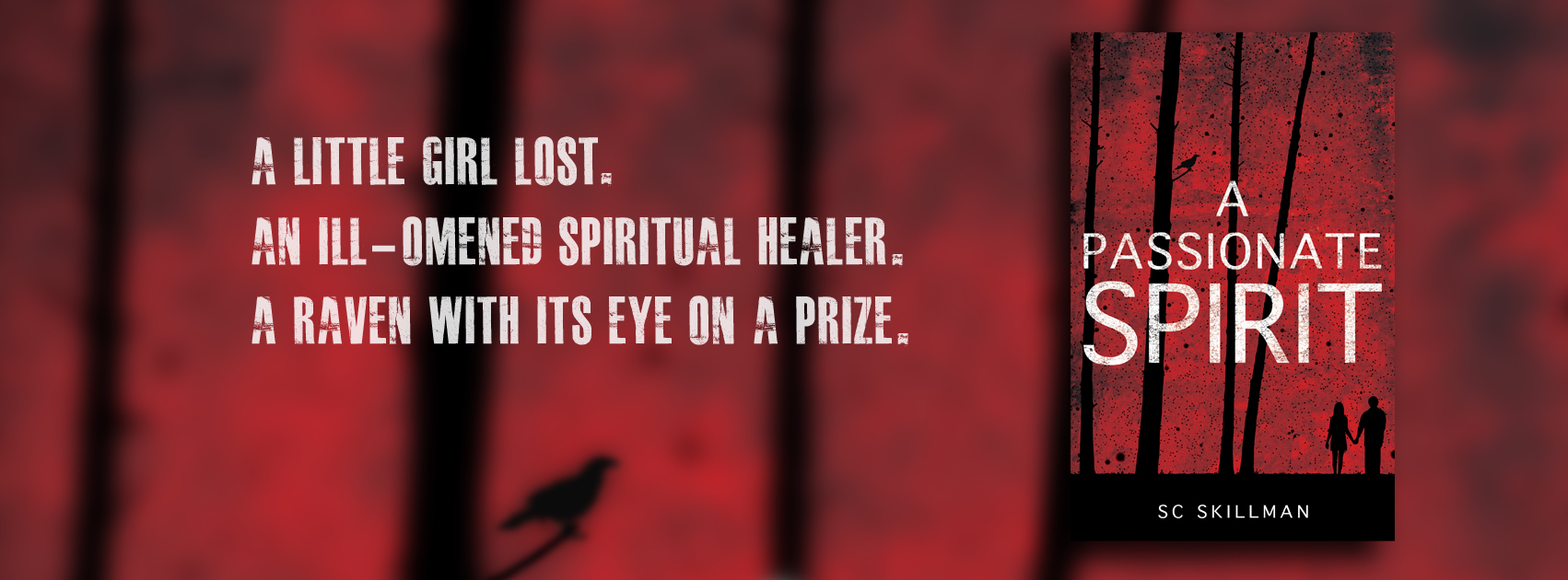
Mystical Circles is psychological suspense, and the sequel A Passionate Spirit a paranormal thriller. You can order signed copies here. Or download them to your kindle as follows:

getBook.at/MysticalCircles

getBook.at/PassionateSpirit

Subscribe to my mailing list and get a free epub Pursuing Your Creative Passion, a taster from my inspirational writer’s guide Perilous Path: A Writer’s Journey – packed with encouraging tips, insights and reminders for writers. 

Subscribe banner (2)

Sign up here.

Here on my blog, I post weekly. I love to have your comments so please keep them coming!  And if you’d like to know more about my next novel Director’s Cut, which I’m working on right now, do sign up for my mailing list here.

a-passionate-spirit-cover-image-with-taglineI studied English Literature at Lancaster University, and my first permanent job was as a production secretary with the BBC. Later I lived for nearly five years in Australia. I now live in Warwickshire with my husband David and son Jamie, and my daughter Abigail is studying for a Masters at university in Australia.

I completed two full-length adult novels before writing Mystical Circles. I’ve always been fascinated by the interaction of different complex personalities, an inexhaustible source of inspiration for a writer!

And my advice to anyone who wants to be a writer? Read a lot, listen to people’s conversations, be observant about the details of your world, and especially about human behaviour and interaction, and persist in your writing, being single-minded to the point of obsession…never give up, always believe in yourself despite all evidence to the contrary,(Click to Tweet) and hold out for what you first dreamed of.

Thank you for reading this. And if you want to be first to hear about my next novel, which is currently in progress, do sign up on my email list here.

The Pessimistic Optimism of the Long-Distance Creative Writer

After being turned down by numerous publishers, he had decided to write for posterityGeorge Ade

 It is a truth certainly acknowledged by the author of the above quote that many creative writers struggle for years, enduring perhaps decades in the wilderness of submissions and rejections, before their persistence finally pays off. 

Most would-be authors, says Alison Baverstock in The Artists and Writers Yearbook, “are pessimistic optimists.”  And The Old Testament is full of stories of people who waited or fought seemingly in vain or wandered in wilderness for many years before God’s plan for them unfolded, and their gifts were used and they prospered.

Joseph, Moses, and Elijah come to mind.  Moses was 80 years old when he led the Children of Israel out of Egypt, and witnessed the parting of the Red Sea.  Elijah gave way to depression before God re-commissioned him.  Joseph languished forgotten in jail before his gift for interpreting dreams lifted him up again.

Fast forward a few thousand years to my chance meeting with a publisher (later to become one of London’s top literary agents) who took an interest in my writing.  He encouraged me to write my first novel. 

 Not long ago I attended an evening on Discernment, and an image was presented to us: “You can spend years knocking on doors.  Some doors lead to broom cupboards and some to elevator shafts.” 

When I met this publisher, in the early stages of my writing career, I opened a door and it led into a lift.  I stepped in, and went up.  But it was a faith-operated lift.  It required me to have enough faith to press the button for the top floor.  I only had enough faith to press the button for Floor 3.  The doors opened, the demon of self-doubt stepped in, and pressed the button for the basement.  And down I went again, to the very bottom of the shaft.

So, as my writing life continued beyond the outer gates, thick brown envelopes dropped on my doormat, and I opened letters saying things like We read this with much amusement but in the end were not sufficiently drawn to the central idea and We found your style fluent and assured but it is not quite for us  and Although this is witty and well written… our fiction programme is so full that we are buying very few new titles unfortunately…. I wish you success in finding a less over-burdened publisher.

 But I later discovered that, contrary to the feelings of rejected authors, when you actually meet editors in publishing houses, they’re very pleasant people.  The Mills and Boon editor I met in the Ladies at the Savoy, at the RNA Romantic Novel of the Year Award luncheon, was very nice.  And so was the Rights Director for the top agent I referred to earlier in this article, whom I met later in the dining room. She reminded me of a member of my babysitting circle. (This lady still rejected my novel when I sent it to her though, and subsequently left the agency and published a novel herself).

And so I continued to open letters saying, Due to the very strong market in this kind of literature your novel would not be viable for us to publishThis is too commercial for usI’m afraid this doesn’t quite fit with our current list.   

Then I read Margaret Silf’s book Sacred Spaces, and found these words in her chapter on Crossing Places

At this ‘burial plot’ of my experience, I am standing between two worlds – between the old, the known and understood, and the new beginning which still lies beyond the scope of my wildest imagining. I am standing in sacred space because it is on the very edge of the known that the infinite possibilities of the unknown begin to unfold.

 She went on to say: 

God stretched the rainbow across the heavens, so that we might never forget the promise that holds all creation in being.  This is the promise that life and joy are the permanent reality, like the blue of the sky, and that all the roadblocks we encounter are like the clouds – black and threatening perhaps, but never the final word.  Because the final word is always “Yes!”