Good Friday, The Magic of Believing, and Success and Failure

Once I tried to live by the magic of believing, in which positive thoughts always attract good circumstances into our lives – until I realised success and failure in this world cannot be understood in such a simplistic way. How straightforward life would be if that was so.

The truth is none of us know for sure to what we must attribute success or failure in life.  Some flourish in this world who by any moral law should not do so – including those dictators who hold onto power and wealth for many years by the sheer force of terror. And sometimes people can think positive thoughts, and it leads them on a path of suffering.  I think of the young girl at my daughter’s school who learned she had been diagnosed with leukaemia, smiled and said, “I’m lucky to have lived until now,” and then lived out the rest of her brief life with a sunny, cheerful, positive attitude.

I’m also reminded of the group of nuns who went out to El Salvador to offer care to the oppressed people, and all met violent deaths. Their story is told by Sheila Cassidy in her book Good Friday People.  Here she gives other examples, too, of people who set their faces towards suffering, just as Jesus “set his face towards” Jerusalem (where he would be arrested, tortured, tried in a kangaroo court, sentenced to death, and crucified).  

I write this on Good Friday, when we reflect upon Jesus whose love took him on a path of suffering. It  led to the Cross – in worldly terms the ultimate failure.  And yet  the true significance of Good Friday is the triumph of love over evil. We do not flinch from the Cross but dare to wait at the foot of it – not to wallow in shame and guilt (as some suppose) but to receive the grace, love and peace poured out freely for us. And when I think of that grace, love and peace, there at Golgotha, the darkest of places, I can see the Christian resonance in these words from J.R.R. Tolkien: “May it be a light to you in dark places, when all other lights go out.”

The Wailing Wall, Sacred Space and Topol

A recent 24/7 prayer weekend at church created a “sacred space” in a room, where people could come and reflect, and paint and write and draw, and meditate in a tent or tie a leaf to a tree or write their angst on a paper chain then break the chain and tear it to pieces and throw it away. But what struck me most was “The Wailing Wall”. Here people could post their anger and doubts and frustrations to God.

And what I discovered was the amount of anguish going on below the surface. “My yoke is easy and my burden is light,” said Jesus. If you’re a music lover you may have heard of these words in Handel’s Messiah. What Jesus says is: Let go of all your worries and anxieties and lay them on me. And in this lies the value of the Wailing Wall (as used in our 24/7 prayer weekend).

The Wailing Wall in Jerusalem  – the tradition of pouring out anguish to God – from the Lamentations of Jeremiah through to Topol in The Fiddler on the Roof is a powerful tradition.

 Come to me… Keep company with me and you’ll learn to live freely and lightly is how Eugene Petersen expresses Jesus’ words in his wonderful paraphrase of the Bible in streetwise language, The Message. Come unto me all ye who are burdened and heavy laden and I will give you rest.

An Artist’s Feeling for Light and Relationship with the Creative Writer

“Show don’t tell” is one of the most common pieces of advice given to a writer; and this is the case with artists too. Yet sometimes we like to hear an artist explain their method of working. And so the other day I listened to Phyllis Davies, Painter and Textile Artist, as she discussed her art at a presentation to the Association of Midland Artists in Leamington Spa. As she displayed her vibrant wall-hangings, hand-embroidered on digitally printed fabric, she spoke of her feeling for light.  Warmth and coolness, sunlight and shadow, these command her attention first of all, and lead her on to consider texture, line, mass, colour and design. The artists I love the most are those for whom the variation of light is where it all begins. A good example of this, from another period, is Leonardo Da Vinci’s The Virgin of the Rocks, which has long been one of my favourite artworks. The quality of the light and shadow in this great painting fills me with awe.

Phyllis Davies finds her inspiration in Venice, and her glorious wall-hangings are full of the opulence and brilliance and splendour of that city.  She said: “it is always more interesting to look at things through something else.”  So as an artist she prefers to view a basilica, a bridge, a church, through a fence. And this reminded me of the exhibition I reviewed a few weeks ago, Lost in Lace at the Birmingham City Art Gallery & Museum. Everything there was defined by spaces and holes and boundaries, even to the point of one artist tying threads round holes in fences.

Another abstract feature stood out in my mind from Phyllis’s presentation: movement and stillness. She represents this through variation of light and colour, and in the viewpoint she takes of Venetian scenes.  To me, listening to an artist describe how she works is something that feeds directly into how I feel about creative writing. Movement and stillness translates into pace and tone and mood. Warmth and coolness, sunlight and shadow, all play their parts in a novel, as we consider the effect of positive and negative, high emotional stakes and the subtle passing of information – the art of “showing” and not “telling”. Whether the novel is literary or popular, I still feel that these elements are present, there in the writer’s art. 

SC Skillman

Welcome To My Blog – About Me

Author photo SC Skillman

Thank you for visiting my blog! I write psychological, paranormal and mystery fiction and non fiction.

I’m a member of the Society of Authors and the Association of Christian Writers.

My new book Paranormal Warwickshire is out now from Amberley Publishing.  It’s available everywhere good books are sold. If you’d like a signed copy sent to any UK address, just pay £12.50 here and include a note of your postal address, and any requests for a special message, and I’ll post you a signed copy at once.

Mystical Circles is psychological suspense, and the sequel A Passionate Spirit a paranormal thriller. You can order signed copies here. Or download them to your kindle as follows:

getBook.at/MysticalCircles

getBook.at/PassionateSpirit

Subscribe to my mailing list and get a free epub Pursuing Your Creative Passion, a taster from my inspirational writer’s guide Perilous Path: A Writer’s Journey – packed with encouraging tips, insights and reminders for writers. 

Subscribe banner (2)

Sign up here.

Here on my blog, I post weekly. I love to have your comments so please keep them coming!  And if you’d like to know more about my next novel Director’s Cut, which I’m working on right now, do sign up for my mailing list here.

a-passionate-spirit-cover-image-with-taglineI studied English Literature at Lancaster University, and my first permanent job was as a production secretary with the BBC. Later I lived for nearly five years in Australia. I now live in Warwickshire with my husband David and son Jamie, and my daughter Abigail is studying for a Masters at university in Australia.

I completed two full-length adult novels before writing Mystical Circles. I’ve always been fascinated by the interaction of different complex personalities, an inexhaustible source of inspiration for a writer!

And my advice to anyone who wants to be a writer? Read a lot, listen to people’s conversations, be observant about the details of your world, and especially about human behaviour and interaction, and persist in your writing, being single-minded to the point of obsession…never give up, always believe in yourself despite all evidence to the contrary,(Click to Tweet) and hold out for what you first dreamed of.

Thank you for reading this. And if you want to be first to hear about my next novel, which is currently in progress, do sign up on my email list here.

The Pessimistic Optimism of the Long-Distance Creative Writer

After being turned down by numerous publishers, he had decided to write for posterityGeorge Ade

 It is a truth certainly acknowledged by the author of the above quote that many creative writers struggle for years, enduring perhaps decades in the wilderness of submissions and rejections, before their persistence finally pays off. 

Most would-be authors, says Alison Baverstock in The Artists and Writers Yearbook, “are pessimistic optimists.”  And The Old Testament is full of stories of people who waited or fought seemingly in vain or wandered in wilderness for many years before God’s plan for them unfolded, and their gifts were used and they prospered.

Joseph, Moses, and Elijah come to mind.  Moses was 80 years old when he led the Children of Israel out of Egypt, and witnessed the parting of the Red Sea.  Elijah gave way to depression before God re-commissioned him.  Joseph languished forgotten in jail before his gift for interpreting dreams lifted him up again.

Fast forward a few thousand years to my chance meeting with a publisher (later to become one of London’s top literary agents) who took an interest in my writing.  He encouraged me to write my first novel. 

 Not long ago I attended an evening on Discernment, and an image was presented to us: “You can spend years knocking on doors.  Some doors lead to broom cupboards and some to elevator shafts.” 

When I met this publisher, in the early stages of my writing career, I opened a door and it led into a lift.  I stepped in, and went up.  But it was a faith-operated lift.  It required me to have enough faith to press the button for the top floor.  I only had enough faith to press the button for Floor 3.  The doors opened, the demon of self-doubt stepped in, and pressed the button for the basement.  And down I went again, to the very bottom of the shaft.

So, as my writing life continued beyond the outer gates, thick brown envelopes dropped on my doormat, and I opened letters saying things like We read this with much amusement but in the end were not sufficiently drawn to the central idea and We found your style fluent and assured but it is not quite for us  and Although this is witty and well written… our fiction programme is so full that we are buying very few new titles unfortunately…. I wish you success in finding a less over-burdened publisher.

 But I later discovered that, contrary to the feelings of rejected authors, when you actually meet editors in publishing houses, they’re very pleasant people.  The Mills and Boon editor I met in the Ladies at the Savoy, at the RNA Romantic Novel of the Year Award luncheon, was very nice.  And so was the Rights Director for the top agent I referred to earlier in this article, whom I met later in the dining room. She reminded me of a member of my babysitting circle. (This lady still rejected my novel when I sent it to her though, and subsequently left the agency and published a novel herself).

And so I continued to open letters saying, Due to the very strong market in this kind of literature your novel would not be viable for us to publishThis is too commercial for usI’m afraid this doesn’t quite fit with our current list.   

Then I read Margaret Silf’s book Sacred Spaces, and found these words in her chapter on Crossing Places

At this ‘burial plot’ of my experience, I am standing between two worlds – between the old, the known and understood, and the new beginning which still lies beyond the scope of my wildest imagining. I am standing in sacred space because it is on the very edge of the known that the infinite possibilities of the unknown begin to unfold.

 She went on to say: 

God stretched the rainbow across the heavens, so that we might never forget the promise that holds all creation in being.  This is the promise that life and joy are the permanent reality, like the blue of the sky, and that all the roadblocks we encounter are like the clouds – black and threatening perhaps, but never the final word.  Because the final word is always “Yes!”

Highly-focused, intense, and brilliant: The First Hunger Games Film

Jennifer Lawrence stars as 'Katniss Everdeen' in THE HUNGER GAMES.

The Hunger Games trilogy by Suzanne Collins provides a very exciting, stirring read, engaging young adults – and now of course adults too – with major issues in today’s world.

image of The Hunger Games book 1 cover

I saw The Hunger Games movie having read the trilogy a couple of years ago. I found the books compelling in their narrative of horrific events, in the end delivering several shocks with the deaths and betrayals of characters I liked, but also some ingenious turning points. I felt the final outcome could have been more redemptive / uplifting, especially in view of the epic forces of good and evil this story deals with.

The forces of evil in this hypothetical future America are spiralling decadence, selfishness, obsession with glamour, image and celebrity, and inhumanity – and looking at our own world, if these forces were to reach a certain pitch we can see they would indeed lead us to some such outcome as the Hunger Games. In Panem, the inhabitants of The Capitol revel in the ultimate reality TV, entertained by the violent deaths of randomly drawn teenage “Tributes” from the oppressed

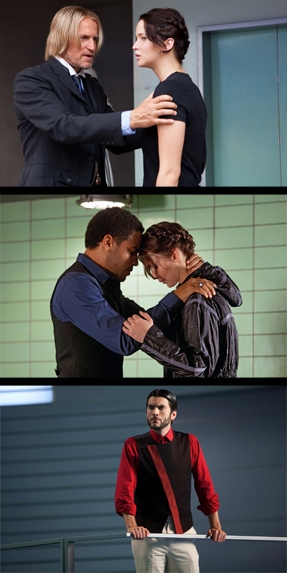
Haymitch, Cinna and Seneca
Haymitch Abernathy (Woody Harrelson), Cinna (Lenny Kravitz) and Seneca Crane (Wes Bentley)

Districts. Those Capitol citizens behave just as the crowds did in the  ampitheatres of Ancient Rome. The fact that  the young people drawn by lot then sent out to fight to the death are first glamorised, feted and paraded in front of the cameras  alongside an oily TV host, makes it even more chilling. Another strong motif is the vacuous sentimentality of the massed audience, leading them to gush at a possible love affair between the main protagonist Katniss and her fellow-tribute Peeta whilst being equally ready to watch them meet a horrible death at the whim of the Gamemakers under the merciless direction of their Chief, Seneca Crane.

What stood out for me in the movie was Katniss herself. Played by Jennifer Lawrence she was  totally absorbing. Her compassion, her courage, her survival skills and her subtle resistance of the evil in which she was forced to take part shone out.  The intense concentration on Katniss’s every move in the Arena made me feel I was there with her. Our attention and our hopes were 100% on Katniss. The empathy and support she won from her allies Haymitch and Cinna also made a strong emotional impact.

The premise of the story, and narrative flow of the movie was highly unusual and intense. The cinema audience sat in silence throughout, a silence to match the silence behind the action for the first part of the film – save for a few moments in the last half of the film when emotional reactions were inevitable! Brilliant, unforgettable and a sharply-focused portrayal of some of the worst excesses of the western world taken to their logical conclusion.

Wisdom from Hermitage, Cave and Monastery

a sadhu (Hindu holy man) in the Himalayas

Sometimes you hear people say “What’s the use of being a solitary contemplative?” How can any of humanity’s problems be resolved by those who withdraw from the world, to live the life of a hermit or a monk? The vital role of the sadhu or holy man is long established in Indian tradition; and renewed interest in monasticism in our society in recent years has focused our attention on The Monastery TV programmes exploring the work of Abbot Christopher Jamison at Worth Abbey in Sussex. His book Finding Sanctuary is one of the finest spiritual books I’ve ever read.

Abbot Christopher Jamison

 Gifts from the hermitage or monastery or cave may not necessarily come through words. Years ago, I met a sadhu, a Hindu holy man, in the Himalayas. He lived in a cave above Badrinath (the last Indian town of importance before the Tibetan border, and place of Hindu pilgrimage).  He was happy to pose for a photo. Thereby he gave me something of great value:  the serene, tranquil look in his eyes was one of the most powerful memories I brought back from India; an image which would endure for years.

Imagine receiving wisdom and prophetic insight from a solitary contemplative, whether this be sadhu or monk or sage.  Thomas Merton, Trappist Monk (1915-1968) was one of the twentieth century’s greatest spiritual writers, and a prolific correspondent for thousands who wrote to him. Now, reading his  Precious Thoughts I feel as if I’m viewing daily posts from his blog. As I read each one I can see clearly the question his correspondent asked him, the problem that person was troubled by.

Precious Thoughts by Thomas Merton

For example someone had evidently written to him concerned about the suffering that animals experience, and whether God cares, or has anything to do with it (a subject of interest to all animal rights activists). Merton replies: Who is to say that He does not in some way Himself suffer in the animals what they suffer? God cannot simply look on ‘objectively’ while His creatures suffer. To imagine Him doing so is to imagine something quite other than God.

Then there was his reply to a writer who had shared her impatient anxiety (something I know well) about the way things were working out in her life; and Merton wrote: Do not attach too much importance to any individual happening or reaction … you cannot scheme, you cannot figure, you cannot worm your way out of it. Only God can unlock the whole business from the inside, and when He does, then everything will be simple and plain.

Treasure the wise contemplatives of this world. They are indeed precious to humanity.

Literary Criticism, Joseph Conrad Corns and Jane Austen’s Irony

A friend recently asked me this question on behalf of her daughter, an Eng Lit A level student: “How do you analyse a novel?” And I tried to be helpful… but what strikes me most about literary criticism is that even though you may analyse a novel on many levels, according to the personal preference of the analyst, none of it  may bear any resemblance to the author’s original intention.

I am taken back to my university days; and both Jane Austen and Joseph Conrad rise up before my mind’s eye. What is all this about Jane Austen? What is there in her? What is it all about?  wrote Joseph Conrad to HG. Wells in 1902. (See Claire Harman’s website for more on this!)

I recall my first Eng Lit seminar at university. Before us was Jane Austen’s novel Emma which we’d all been asked to read during the vacation. Our tutor opened by asking, “Does anybody here actually like Jane Austen?”  Silence met this question. Then I foolishly said, “Yes.” “Why?” he shot at me. “Her use of irony,” I said. “Read me a passage from the book which demonstrates her use of irony,” he said. The spotlight was on me. My mind blanked. I flipped through the book, totally unprepared, panicking. “All of it is ironic,” I said.

At that time I was naive and unprepared for the kind of critical thinking university study requires of you. I soon became more streetwise, but even so there was no way to avoid being caught out. Another tutor opened a seminar with the words: “Today we are going to look at Sylvia Plath as victim and product of society.” Later on in the discussion, he targeted me with the words, “And what about you, Sheila? Surely this relates to your earlier theme, doesn’t it?” And I couldn’t remember what my earlier theme was.

The final word goes to a third tutor (a world authority on Joseph Conrad with a long list of acclaimed publications behind him) who walked into a seminar room where we sat with Heart of Darkness and The Secret Agent before us: “Now, come on; who’s going to step on my Joseph Conrad corns?” Later we considered Conrad’s motif of overweight villains. In The Secret Agent  we read that Mr Verloc is:   “… fat – the animal.” “What a horrifying vision of humanity,” mused our tutor. “I must slim.”

Favour, privilege, and royal fairy dust

My son mentioned to me that he had learned from Newsround that Garry Barlow of Take That had asked Prince Harry to sing a line in one of their songs. And that Harry had (so far) refused. This led to thoughts about royal power and privilege; especially as I later watched the excellent TV programme “She-Wolves” presented by Helen Castor, the author of a book of the same name. Only a cursory study of the Plantaganets is needed to remind us that the history of the English monarchy is bloody and turbulent. It is inconceivable these days that a royal figure (in this country) would dare to be seen favouring someone for their personal benefit. And then I arrived at the most interesting element of this:  that we have developed a culture which incentivises royalty to behave in this way.  Royal fairy dust cannot be seen to create personal privilege. Our royal family is truly accountable to the people.

In former times wealth, power and success was in the gift of the monarch. If you fought for the right person, and he won, and got his hands on the throne, you could benefit richly from it – perhaps an estate or a substantial parcel of land, or a magnificent property… And thus we have the stately homes that scatter this country, to our enjoyment, many of which have fallen safely into the care of the National Trust: the fruits of royal privilege, returned to the people.

And so back to the question whether Prince Harry will agree to make a musical contribution to Gary Barlow’s Diamond Jubilee song… who knows? But I suspect the answer will remain a courteous and good-humoured “No.”

How Do You Write About a Character’s Thoughts?

This was the question my teenage daughter posed when I said: “Ask me any question about writing novels. What would you like to know?”  So I replied, “Put it in italics.” But I hasten to add that I don’t think that was the answer she wanted. Nor do I believe it really does provide the solution. So I’ll just try and unpack what I think she meant.

There are of course, at a superficial level, ‘different ways to write people’s thoughts’. The author tells you what the character thinks; or the thoughts are given directly in italics; or the novel is written in first person narration and gives thoughts direct to the reader. Certainly, novels which have directly conveyed the character’s thoughts are most powerful, and they haunt my memory. Among them is John Fowles The Collector.  Indeed, this is a terrifying example. Here we are taken by the hand and led into the world of a first person narrator who is criminally insane. We are inside his head. And of one thing we can be sure: we wouldn’t like to be at his mercy, or meet him down a dark alley. The second part of the book is told through the viewpoint of his victim. This is a stunningly successful device. With novels like this, any kind of value judgement by the reader is cancelled. I read the book in a state of concentrated attention that was devoid of any sort of “background chatter”. I had a similar experience when I read Wladyslaw Szpilman’s memoir of survival in Warsaw 1939-45, The Pianist. There are some stories which are so razor-sharp and the events so stark that descriptions of emotion or on-the-spot evaluation by the first person narrator are redundant. A third example can be seen in Susan Hill’s The Various Haunts of Men when she takes us inside the mind-set of the killer. Again no judgement is placed upon this by the author; it’s unnecessary. His chilling worldview alone makes its impact, alongside our knowledge of the various deceptive roles he plays in society, for the benefit of his victims.

Ultimately the answer to my daughter’s question is: be scrupulous, sparing and self-disciplined in the way you show your viewpoint character’s thoughts. It’s a difficult lesson to learn. Over-indulgence is a sure sign of amateurism. And it’s a lesson all but the most brilliant writers never stop learning.