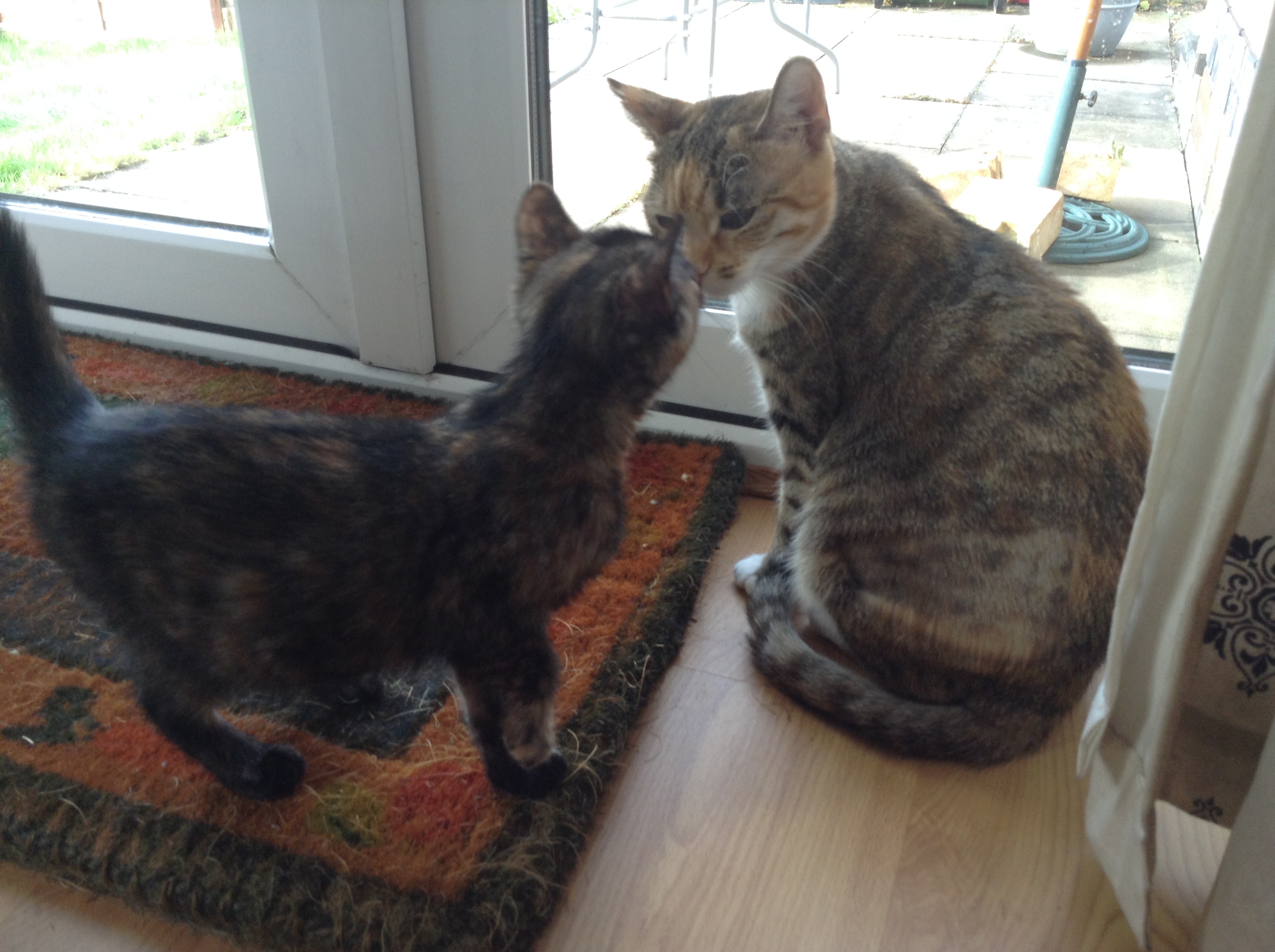
Molly has now overcome her resistance to the idea of an alien cat in the house with her (albeit her mother)
But it took Willow a little while to overcome her annoyance at her daughter Molly’s initial rejection of her.
Willow and Molly 27 Oct 2013 (photo credit Abigail Robinson)
She spent a few days expressing her annoyance, and trying to exert some discipline.
She was a strict mother,and we watched her setting the boundaries.
“Behave!” she would say to Molly.
And then she discovered what it’s like to have your young one defying orders.
And later I was reminded of one of those classic situations which many young mothers bemoan; the toddler who won’t even let her mother go to the toilet alone.
Molly has been pushing at the door of the litter tray while Willow is in it, trying to jump in with her.
“Can’t I even go to the toilet in peace?” cries Willow.
Now we hear the scampering of feet across the floor as the two play-fight with each other and chase each other from room to room.
Relaxing? No. And sometimes those play-fights look horribly real.
But I reassure myself that the claws are retracted.
Otherwise the squeals and squeaks and cries that come from 8 week old Molly would be screams of pain.
Watching a relationship of mutual trust being built in the animal world has made me reflect on how this may apply to us humans too. Suspicion breaks down, the first tentative steps are taken; building trust is a process of experimentation and small moves forward. So we see ourselves and our own characters partially reflected in animal behaviour.
Mother and daughter relationships – a popular trope in TV sitcoms/family sagas/romantic fiction/women in jeopardy/social and romantic comedies and many other stories.
And in the last few days my family have been immersed in a poignant drama in our home between a mother and a daughter.
A mother who was separated from her little girl three weeks ago, and is excited to be together with her, and who longs to come close and look after her again.
And a baby who was separated from her mother, but now they’re reunited, she’s suspicious and hostile.
She spits, hisses and growls at her mother. And the hurt mother, cross and rejected, growls back – through the glass door that separates them.
The name of the mother: Willow, age 18 months.
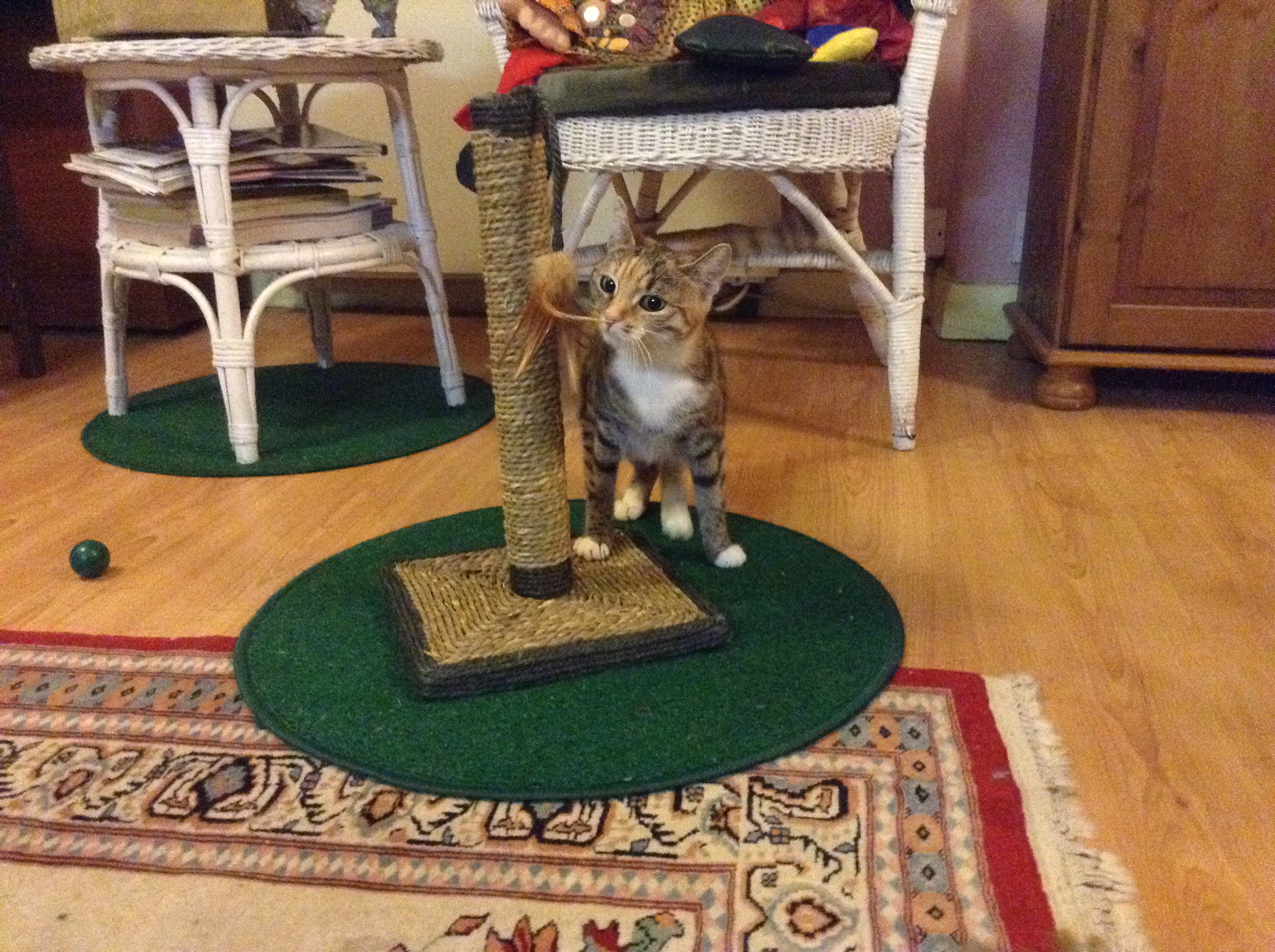
Willow investigating the scratching post (photo credit Abigail Robinson)
And the name of her little daughter: Molly, age 8 weeks.
Molly age 8 weeks (photo credit Abigail Robinson)
Willow is a tortoiseshell/tabby cat and Molly a sparky little dark tortoiseshell.
Ever since Willow and Molly arrived in our home, side by side in their cat-carrier, courtesy of the Cats Protection League two days ago, I’ve watched this little family drama in the world of felines with a mixture of emotions.
And so has my own teenage daughter.
“It’s your mum! She just wants to be nice to you!”
No, she’s hiding in a hammock of her own creation at the back of the sofa; a hammock we’d never known was there.
Perhaps next week when I blog again, mother and daughter will be reconciled and happily curled up together again.
Rev Kenny Borthwick, Church of Scotland minister (photo credit holytrinity-westerhailes.org.uk)
This is just one among many cliches in the English language that we use without thinking.
Yet how often do we stop to realise they are meaningless?
Who sends these hard things to ‘try’ us? An almighty sadist in the sky?
This stands as one of the most popular arguments against Christianity. How can a supposedly all-loving sovereign God allow terrible things to happen to innocent people?
When I was in the sixth form at school we had an atheist English teacher who enjoyed challenging us on a personal level, arising from discussions about Thomas Hardy’s Tess of the d’Urbervilles.
Thomas Hardy was “a philosophic pessimist” and in Tess’s tragedy he suggests there is no purpose or meaning to her suffering, other than that “we live on a blighted star.”
Our teacher said, “All the evidence suggests that there is a random pain-inflictor, scanning round over human affairs, occasionally dropping a huge lump of tragedy onto someone.”
Discuss.
This would indeed be a good exam question in Religious Studies.
Two days ago I listened to a Church of Scotland minister, Kenny Borthwick, talk about why God does not send things to try us, and why the real battle when we suffer is to hold onto the goodness of God.
God, he said, is not a harsh God whose main aim is to teach us hard lessons through hard things.
Although it is true we can sometimes learn valuable things through suffering, we must be aware of this danger: if you over-stress a truth it can become a lie.
God does not send cancer to teach us a lesson.
God sent Jesus to teach cancer a lesson.
Kenny Borthwick is exactly the opposite of a traditional fire-and-brimstone preacher so beloved of numerous novels written by Catholic authors about their upbringing among religious authorities with a harsh view of God (how can I ever forget the sadistic priest in James Joyce’s Portrait of the Artistas a Young Man?) No religious authority figure has ever spoken to me like that; and yet we somehow recognise the cruelty and the fanaticism in this character.
Benny Borthwick spoke of Christians who magnify badness and repentance and magnify the strictness of God with a zeal He would not own.
Kenny’s message to Christians was this:
“You have been saved into the love of God, the goodness of God that He wants to pour into your life day by day.”
The face of God-the-Judge-Who-could-never-be-pleased disappears for ever.
BUT once we accept this, there is still a process.
When we live from the goodness of God which is limitless, we realise that today and every day we always have something to offer, whoever we are, even if we believe we have nothing – we always have something to give.
We need to reject a false spirituality which is frightened to use words like illness or depression, and frightened to cry and be distressed.
We can live each passing moment as a gift from God.
Jesus gave the water a new history when he turned it into wine.
He can give us a new history, with a sense of our new identity. When we are able to accept this, we can realise that our present doesn’t need to be controlled by our past.
Then we are able to make new choices – hope and trust rather than fear.
Then we can replace the old false spirituality and lies with a great truth:
What do we do about art when we wander around great art galleries and museums?
How I integrate art into my own life, on the wall of my writing space (photo credit Jamie Robinson)
We see wonderful things on the walls and maybe we’re overwhelmed.
These great art works are distanced from us, somehow, by the awesome spaces and dimensions of the gallery.
We could never have these original art works on the walls of our own homes.
But they speak to us. There’s something in them we want to take away, something we want to claim for our own lives. Something that tells us about ourselves, our own hearts and souls.
So what do we do?
As David Tennant’s Doctor said to his assistant Donna in the Doctor Who episode Silence in The Library, “Quick! The shop! There’s always a little shop at the end!”
On BBC Radio 4 Today programme at 8.20am on Wed 9 Oct 2013, two writers with new books out, Desmond Morris (author of The Artistic Ape and Alain de Botton (author of Art as Therapy) discussed art and how it affects our lives. And one of the things they said struck me: “If we did not have art in our lives, the world would be very drab. We need it in our lives. But what do we do about art? We go to the gift shop, and we buy postcards. That way we can integrate the art into our daily lives.”
Desmond Morris made this point:
Art is not to be confined to museums but is part of something much bigger in life….. we do like to surround ourselves with objects that make our lives less drab.
Alain de Botton said what he proposes is that We treat the whole museum much more like the gift shop.
I now say that to my teenage son and daughter whenever we’re in an attraction. Ah-ha. The shop. There’s always a little shop at the end.
Why did I find this striking? Because of what I do, at home, in my space where I write.
I cover the wall with brochures, leaflets, postcards from art exhibitions. Bear in mind that the room needs redecorating, which is why I’ve stuck those images directly onto the wall!
No way can I afford to display original Rembrandt, David Hockney, Verneer on the walls of my home.
But I still integrate art into my life.
I have invited art into my writing space. Each of the images I’ve stuck onto the wall, is a window. A window into another world, another artist’s imagination, another dimension.
In this way, no matter how humble, I integrate something of the artist’s spirit into my own working space.
My dream, wrote the designer William Morris, is a dreamof what has never been… and therefore, since, the world is alive, and moving yet, my hope is the greater that it one day will be… dreams have before now come about of things so good… we scarcely think of them more than the daylight, though once people had to live without them, without even the hope of them.
view from the top of Broadway Tower 1 Oct 2013 (photo credit Jamie Robinson)
William Morris, along with the Pre-Raphaelite brotherhood, and the members of the Arts and Crafts Movement, was one who inherited and took forward all that was good in the Romantic Movement.
Among all things most romantic to me is a high place.
I go to high places for calmness and peace.
There are a number of high places I love to visit, from where I live in Warwickshire.
Broadway Tower, Cotswolds 1 Oct 2013 (photo credit Jamie Robinson)
And just such a place, 35 minutes drive from my home, is Broadway Tower in the heart of the Cotswolds, which I have visited many times, most recently the day before writing this post.
From the top of the tower one may see, on a fine day, thirteen counties.
No wonder idealists and romantics went there in the nineteenth century after their friend took a lease on the Tower, following the death of the Tower’s creator and original owner, the Earl of Coventry. For the Tower, a picturesque folly on the summit of Broadway Hill, emerged from the romantic movement. So, too, flambuoyant, theatrical and sensual, did Painswick Rococo Garden emerge from this tradition, as I wrote in a recent review on Trip Adviser.
William Morris was just one of the many idealists and romantics who came here. His rich, complex and exquisite designs now adorn soft furnishings, and a selection of them may be seen on the second floor of the Tower.
William Morris design image 1 (photo credit Jamie Robinson)
He is a beacon of romantic idealism, combining a love of medieval craftsmanship and Gothic design elements.
And his association with Broadway Tower – together with that of his contemporaries of like mind – is appropriate.
William Morris design image 2 (photo credit Jamie Robinson)
It’s certainly true that I, too, feel an affinity with the Romantics, the Pre-Raphaelites, the members of the Arts & Craft movement, and their dreams and visions.
For where would we be in this life if none among us aspired to, or dreamed of impossible ideals?
Impossible?
Read the full text of The Dream of William Morris here.
The Dream of William Morris (photo credit Jamie Robinson)
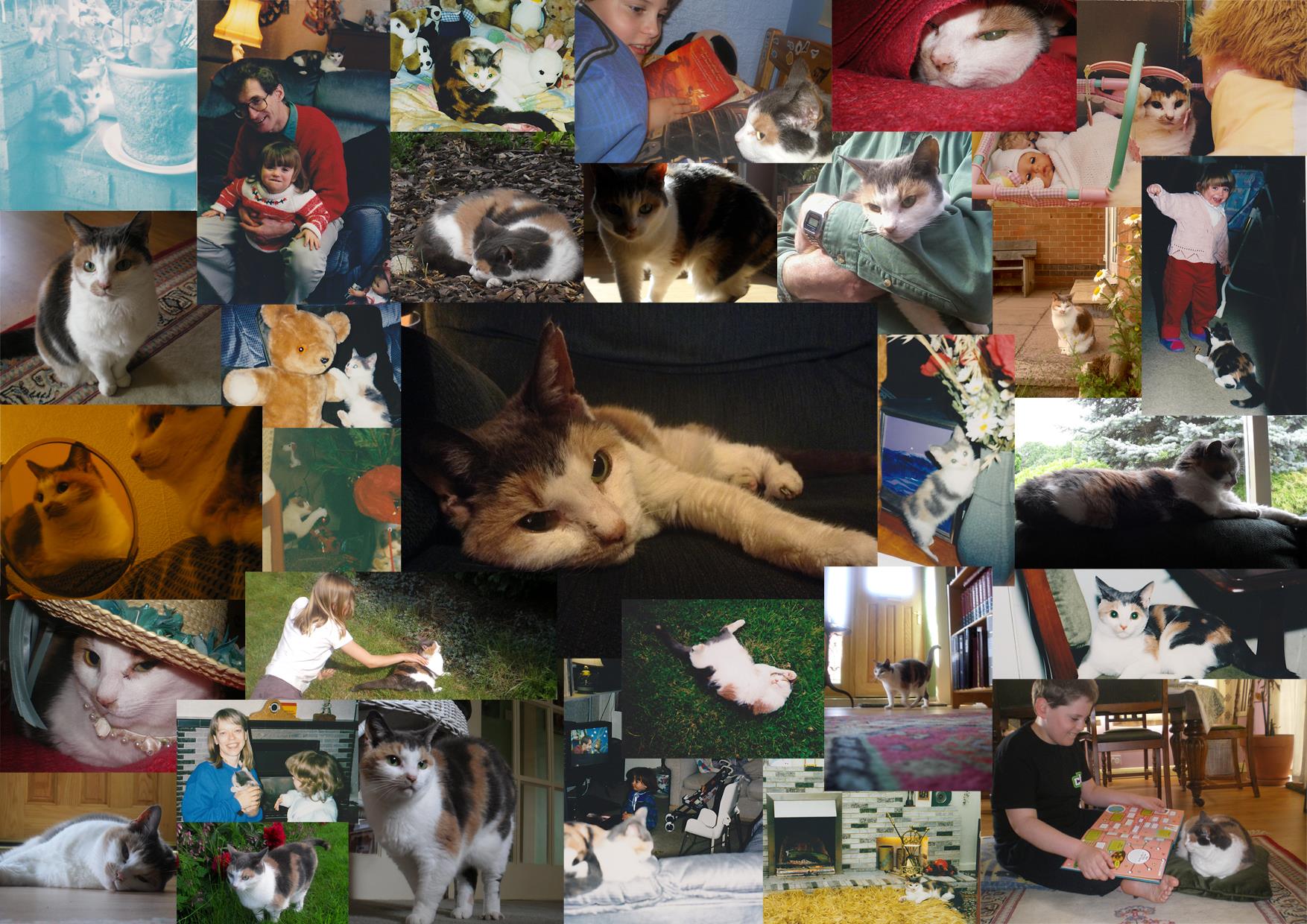
This is Hattie, born 1996, who died on 21 September 2013, at home, in her basket, peacefully, in a deep sleep.
Happy memories of Hattie, beloved family pet 1996-2013 (photo credits: Abigail Robinson)
When a much-loved family pet dies we need to decide what to do next.
But we kept Hattie lying in her basket for a day and a night, nestled in her blanket, where she died.
And it was not macabre, but beautiful, and consoling.
There is something sacred about being in the presence of a peaceful death, after a life well-lived.
Lying there in the stillness and quietness of letting go, her fur still felt soft and her body pliable, and I imagined several times that she was still breathing.
She has filled 17 years of our lives with fun, laughter and affection. She has beguiled us, outwitted us, annoyed us, delighted us and demonstrated something powerful: absolute persistence wins.
I blogged about Hattie a while ago. There, I wrote about the perpetual fascination of cats.
And now Hattie has again demonstrated something powerful about this life.
The gracefulness and the quietness and the beauty of letting go.
It’s been twelve years since I last visited the Cutty Sark at Greenwich – and what a fantastic transformation.
The Cutty Sark 14 Sep 2013 (photo credit: Jamie Robinson)
Greenwich and its neighbouring Woolwich in south London are part of my family background, and so this area has been familiar to me from childhood.
This made my return to view the Cutty Sark even more inspiring.
I found the whole visit very uplifting – appropriately so, as the Cutty Sark herself has been uplifted in the most amazing way!
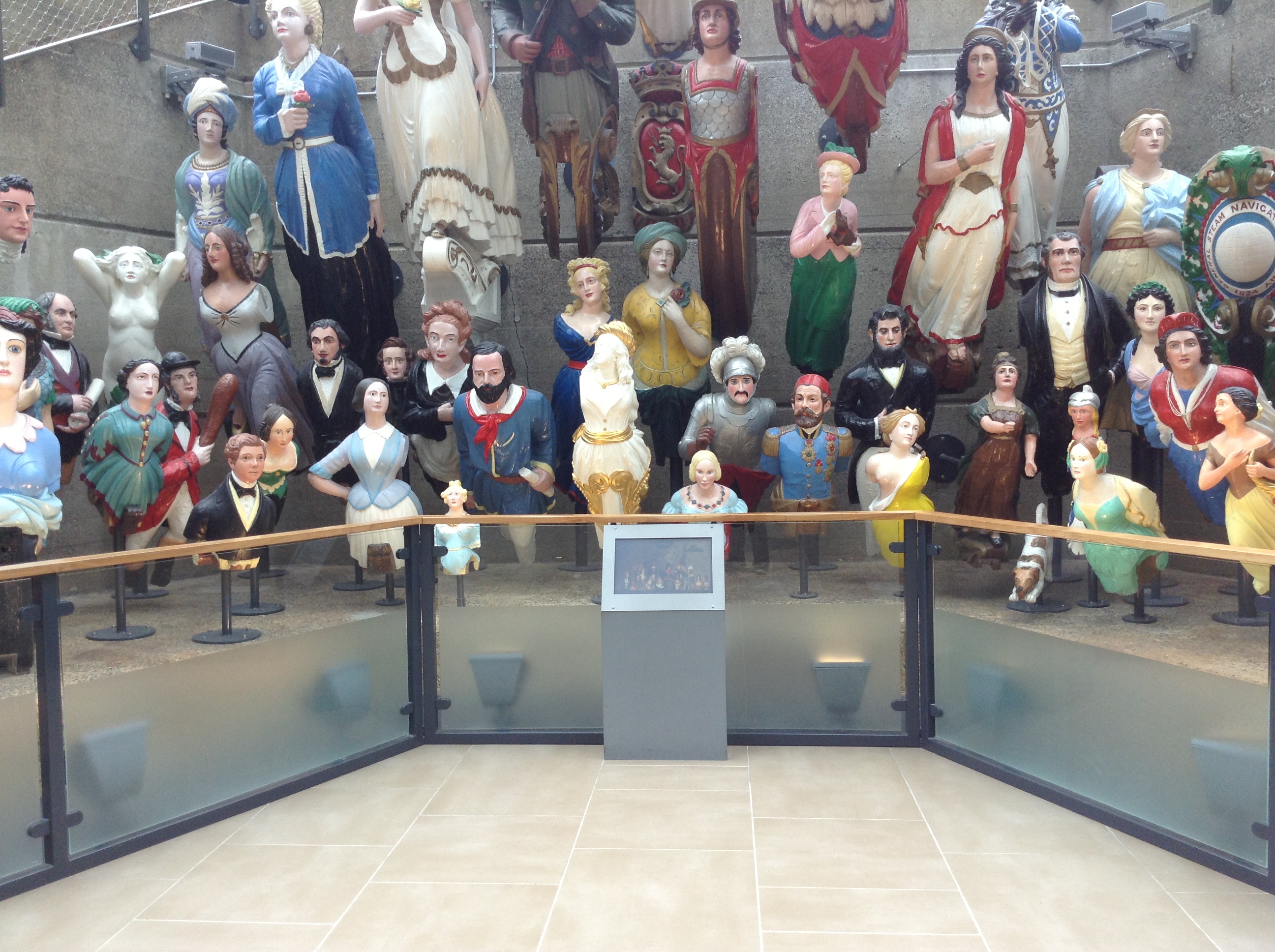
The exhibition area beneath the ship is excellent, with its collection of ships’ figureheads.
Collection of ships’ figureheads at the Cutty Sark (photo credit: Jamie Robinson)
And we were later delighted to find ourselves sitting at cafe tables with the ship apparently hovering just above us.
Everything about this attraction is first class, and it is a credit to London and to our British heritage.
The Cutty Sark uplifted (photo credit: Jamie Robinson)
The high standard is maintained in the shop, too, which is full of stylish souvenirs for sale. How could I, as a writer, resist buying myself an attractive cream and gold spiralbound notebook with the motto on the front: Where there’s a will, is a way.
This motto, carved into the ship’s elaborate decoration, is a play on the surname of Jock Willis who commissioned the Cutty Sark (launched in 1869).
For the twenty-first century transformation of the Cutty Sark can certainly be seen as a perfect illustration of this motto in action.
Enjoying a shady ‘small enclosed space’ in a private Kenilworth garden open for the National Gardens Scheme 1 Sep 2013 (photo credit: Abigail Robinson)
A well-watered garden is a powerful image of creativity, abundance, fruitfulness.
When asked to describe or picture heaven, I often see it as a garden.
The Prophet Isaiah, wrote these words: And the LORD will continually guide you, And satisfy your desire in scorched places, And give strength to your bones; And you will be like a watered garden, And like a spring of water whose waters do not fail.
Isaiah’s choice of a garden for his image here is perfect, as are many of the images he chose for his prophecies: an image which is profound and powerful.
A few months ago during a visit to Hidcote Manor Garden, one of the National Trust’s greatest gardens, we heard the Head Gardener say that because we’ve had a late spring this year, 2013, the plants, like people, benefit from “a good long kip” and so later on, when they flower, they will be more plentiful, more colourful and more abundant.
And so it has proved in three outstanding gardens I’ve recently visited: Upton House, near Banbury; the garden at the Shakespeare Birthplace Trust in Stratford-upon-Avon; and a private garden in Chase Lane, Kenilworth, Warwickshire, part of the Open Gardens event run by the National Gardens Scheme.
flowers in Upton House Garden 23 Aug 2013 (photo credit Abigail Robinson)
As I spend time wandering around these gardens I reflect upon what engages me most in gardens I love:
* a series of small enclosed spaces which are like outdoor rooms – little ‘dens’ where you may sit and contemplate or dream or write or do anything else creative, which are shady, secret, beautiful, tranquil, hidden;
Spending time in the garden – contemplating, dreaming, in a little ‘den’ (photo credit: Abigail Robinson)
* a number of vistas and points from which you may glimpse things either near or distant which may intrigue or surprise;
* in a grand garden with a stunning planting scheme, I’m most enchanted by combinations of depth & colour & shape which evoke different emotions in the beholder; low misty feathery plants in front, then the tall bold gold shapes behind, and finally the purple spiky angular plants at the back: a profusion of different contrasting and complementary shapes and textures.
This is what I saw in the gardens at Upton House when I visited on Friday 23 August 2013.
A predominance of pink and gold with occasional glimmers of white, lilac, purple, burgundy.
A gentle, warm fragrance filled the air; butterflies flocked to the lavender, bumble bees feasted in every direction I gazed.
Upton House Garden 23 Aug 2013 photo credit Abigail Robinson
The whole was in dynamic motion, appearing to me as a vibration of life, shimmering above and around the blossoms.
We are all indebted to those whose gift is to design gardens, select plants, and work hard to create paradise on earth: surely the goal of all the great garden designers. In this life, there is a place for all of us; those who work, those who act, those who are practical, and those who come to see, and to drink deeply, who dream, who draw inspiration, who see visions, and who believe.
Great gardens are places that feed the imagination, provide a source of inspiration, nurture creativity, enrich our dreams, lift our hearts to the divine.
What could be more poignant than a formerly grand mansion, standing on a cliff, now partially demolished, abandoned and desolate?
Guy’s Cliffe House 25 Aug 2013 (photo credit: Jamie Robinson)
Gaping staircases you cannot climb; stone balconies you long to stand on to gaze at the view; empty windows you feel sure a shadowy figure should flit past.
Just such a gaunt mansion is Guy’s Cliffe House, our local romantic ruin, perched atop a cliff above the River Avon, catching the imagination of all who pass by on the other side of the river.
Guy’s Cliffe House as seen from the footpath on the other side of the river Avon (photo credit Jamie Robinson)
Gothic stone tracery, an ornate balcony, evidence of a flambuoyant builder, remain to tantalize you.
For one of those who occupied the house embellished it with Roman, classical, mediaeval and Gothic elements.
Guy’s Cliffe House so caught my own imagination during the past few years that I occasionally wished that, if I was hugely wealthy, I could pay for it to be restored to its former glory.
In reality, I’d like it to be made safe for people to enter and explore, and for new timber staircases and walkways to be constructed, so we could climb to those balconies and gaze at the view.
And I’d like all the original formal gardens to be restored so people can wander around in them and enjoy the romantic setting.
I feel that Guy’s Cliffe is a poignant illustration of what happens when wealthy property owners do not successfully pass on their property to an equally rich and prudent and competent heir.
One developer/house-breaker deliberately demolished part of the Guy’s Cliffe House, then all the contents were auctioned off, and and accidental fire and neglect did the rest.
We all find it difficult to understand how such a grand property gets damaged, ransacked and neglected like that.
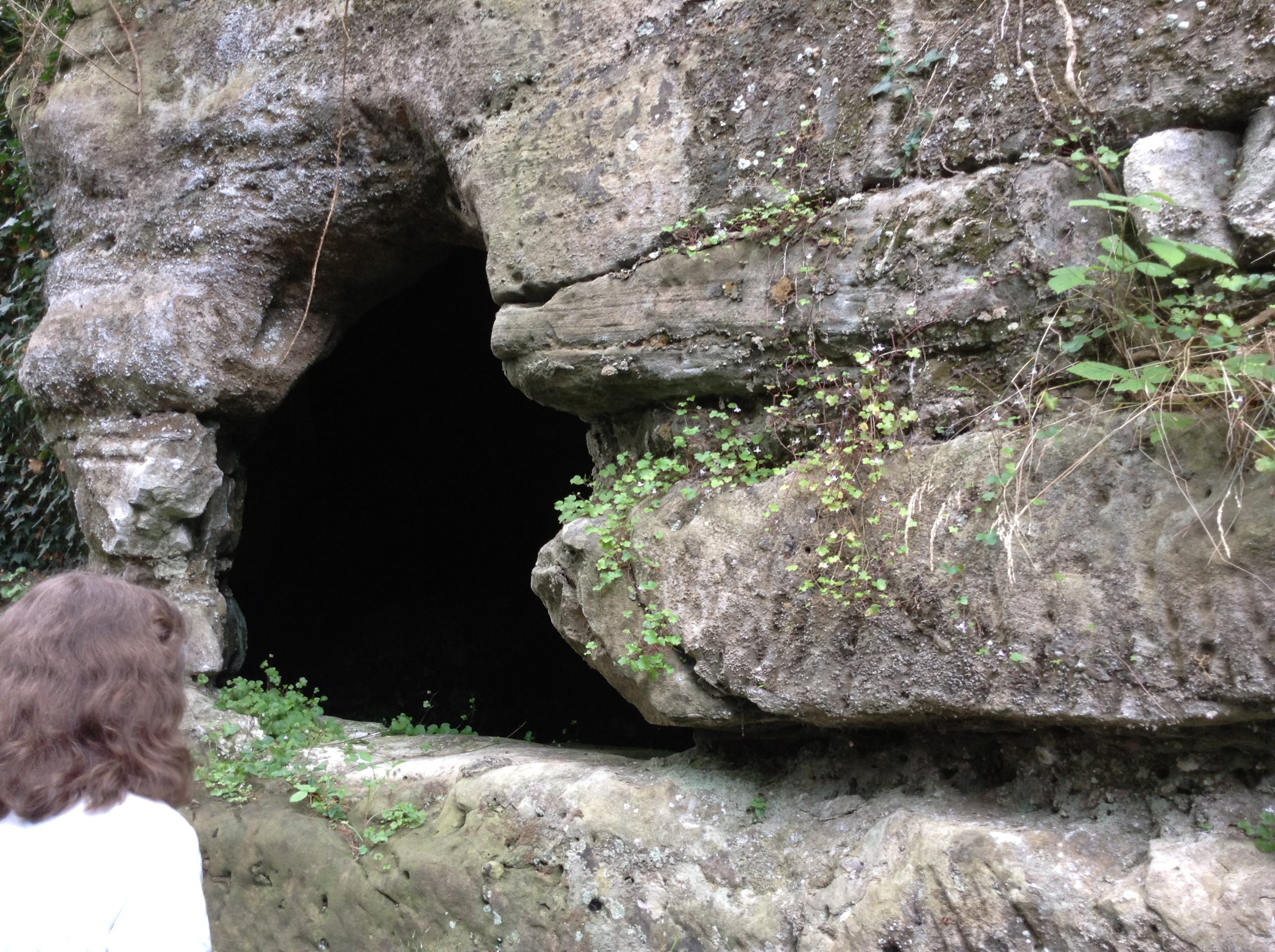
8 foot tall bamboo now crowds close to the cave in the cliff, where Guy of Warwick, in the tenth century, returned from the Holy Land and mysteriously chose to live for two years, rather than reuniting with his wife and child in the house above.
The cave where Guy of Warwick lived for 2 years (photo credit: Jamie Robinson)The chapel of Mary Magdalene with Guy’s Cliffe House behind (photo credit: Jamie Robinson)
And next to the house, the lovely chapel of Mary Magdalene contains Guy’s figure in stone, representing him to be 8 ft high.
The formal gardens have vanished, overgrown by tall trees and shrubs and bamboo.
tall bamboo crowds close to Guy’s Cliff,in place of the earlier formal gardens
It’s like another world – untouched, just left as it is.
So many windows. You feel somebody should appear in them.
We couldn’t fail to wonder and imagine as we took the guided tour around the house and grounds on 25 August 2013, guided by our host Adrian, with an excellent, fluent and richly informative talk.
If you’re in the area of Warwick then don’t forget to book a guided tour round Guy’s Cliffe after you’ve visited Warwick Castle!
I’ve written before about sacred spaces. In that article, I looked at some renowned locations in England where people have felt they’re in touch with something bigger than themselves – a sense of the numinous.
All of these places work symbolically or metaphorically to express a place where we may be or a situation we may encounter in this life, that we recognise from our own experience.
And one such renowned location is Stonehenge – which I visited a few days ago with family members.
To walk slowly and attentively around Stonehenge, using the audio guide provided by English Heritage, is to experience something numinous, much bigger than ourselves.
The stones arrived here some time just before 2500 BC, to begin transforming the previously existing simple enclosure to something much different. And as we considered the huge effort that our ancestors put into moving the stones 19 miles from the Marlborough Downs in north Wiltshire, and 150 miles from the Preseli Hills in Wales, to this location, in order to construct this massive circle, we were drawn in to the wonder and the mystery.
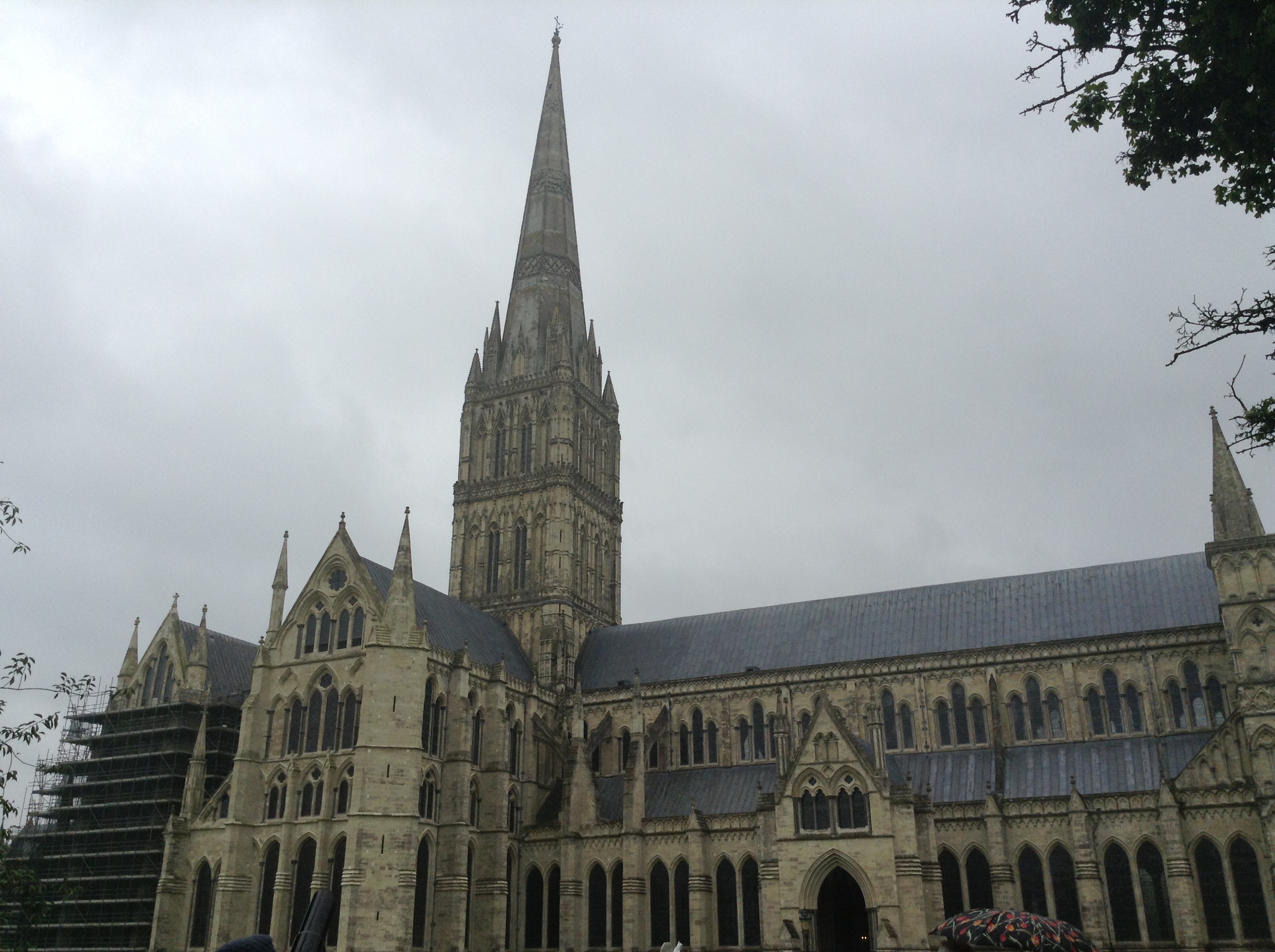
Salisbury Cathedral. Its spire is the tallest cathedral spire in England (photo credit Jamie Robinson)
Those who accept the theory of ley lines know that Stonehenge stands on the Old Sarum Ley which is aligned with Salisbury Cathedral, among other sacred places.
As the English Heritage guidebook points out, Stonehenge can perhaps be seen as the prehistoric equivalent of a great cathedral like that at nearby Salisbury, built for worship and as a place where believers could come to find healing and hope and where important people can be buried.
Salisbury Cathedral, described as Britain’s finest 13th Century Cathedral, is another inspirational place.
From its glorious chancel roof
The chancel roof of Salisbury Cathedral (photo credit Jamie Robinson)
to the stunningly beautiful lapis lazuli of the Prisoners of Conscience windows,
this is a place to move and uplift and fill you with awe.
Prisoners of Conscience window in Salisbury Cathedral (designed by Gabriel Loire; dedicated to prisoners of conscience throughout the world. (photo credit Jamie Robinson)
Here, the hearts and minds of all those who enter, for worship or just to visit, may be lifted up to a bigger and clearer understanding of God.
Or, perhaps, they may receive fresh glimpses of eternity, in much the same way, perhaps, as the hearts and minds of those who built and used Stonehenge over the course of 1,400 years.
Another view of the spire of Salisbury Cathedral (photo credit: Jamie Robinson)
















 scskillman.com