What does Eadfrith, artist-scribe of the Lindisfarne Gospels, have to teach creative writers and artists today?

Nothing much, you may think – because Eadfrith was a seventh century monk in a monastery on an island, and we live in the fast, materialistic, time-pressured world of 2016.
20160822_205715
sunset on Lindisfarne

I’ve just spent three days on Lindisfarne (otherwise known as Holy Island), just off the Northumberland coast, where Eadfrith sat in the monastery scriptorium and scribed and decorated the Lindisfarne Gospels every day for two years between  696 and 698 AD, in order to commemorate the elevation of St Cuthbert’s relics. 

So why is it that the book he created is so revered and has such a hold on our imagination now? – apart  from its age and the wonderful fact of its survival?

20160822_140835
Display in the Lindisfarne Heritage Centre, Holy Island

I believe it’s because of the dedication, the patient concentration and the painstaking artistry that breathes out from the pages, and because of what inspired its creation: love and devotion.

Eadfrith created it “for the glory of God and St Cuthbert”.

St Cuthbert himself inspired so much reverence because he was a holy man, at one time bishop of Lindisfarne, who died as a hermit in 687 on Inner Farne (which I recently visited), and around whose body many miracles occurred.

20160821_120524
Sculpture in St Mary’s Church Holy Island, showing the monks who carried Cuthbert’s body to escape from Viking raiders

The astonishing story of his body, which failed to decay for many years, records how he was carried for several decades by faithful monks around Northumberland, to escape Viking attack, before finally it was laid to rest in the spot over which Durham Cathedral was built. You can visit St Cuthbert’s Tomb in Durham Cathedral, a place which has a strong spiritual resonance and atmosphere of holiness.

The glorious book which is the Lindisfarne Gospels is a testament to patience, concentration, love and devotion. preface to St Mark's Gospel, Lindisfarne Gospels
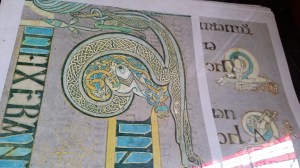
For us now, to gaze at, or to work with, the patterns Eadfrith painted is a pathway to peace and joy – hence the popularity of Celtic colouring-in books for adults, partly because the act of colouring-in forces you to pay close attention and eliminate all distractions. Celtic designs based on the Lindisfarne gospels pop up everywhere20160829_112732 – here’s an image of my lovely metal bookmark displaying Eadfrith’s designs – notice particularly his ornamental birds (Lindisfarne has long been a paradise for birds, so Eadfrith had plenty of them to model his designs on).
20160821_120410
Detail from the Lindisfarne Gospels, in St Mary’s Church Holy Island

In creating the ornamental designs, Eadfrith needed to pay minute attention to the geometrical foundations and symmetry of the overall design – very little was left to chance or the “inspiration of the moment.”

The book he created is now revered not just for the beauty and skill within its pages, I believe, but because that beauty is a physical representation on this earth of a spiritual reality – goodness, peace, patience, holiness and love.

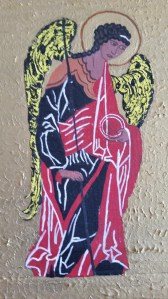
Eadfrith had to source, prepare, or make from scratch everything he used – the parchments of vellum; the pen from a thick reed or quill feather; the ink, from animal, vegetable and mineral raw materials, ground to a fine powder and then mixed with egg white. I have personal experience of something of this latter part of the process at least, because I did an icon-painting course a few years ago and we mixed artists’ pigment with egg-white to paint our own icons on pieces of wood we had ourselves prepared – see the photo here of my own icon of the Archangel Gabriel.20160829_123557
After Eadfrith had created the Gospels, he left the scriptorium and as far as we know he never painted or wrote anything else – not that I’m suggesting this is a model for creative writers of today!

I find his story awe-inspiring and uplifting because it gives me an image of a patient, devoted person sitting alone in a quiet place concentrating absolutely on a work of art, to the exclusion of all else. It makes me think of many others who have created great works in similar circumstances – those who have been perhaps in prison, like St Paul, or Cervantes who wrote Don Quixote, two amongst several examples: or those who have deliberately chosen to go apart into an isolated place like Eadfrith in the scriptorium, free of distractions.

To be free of distractions and able to fully concentrate and devote yourself to the task in hand is such a luxury now, such an ideal for writers and artists to aspire to.


Writing Stories That Grow Legs and Run Away From You


In my creative writing class at Lancaster University years ago, our tutor said to us:  Once written and completed, your work is A Thing on the Table.  The world can make what it likes of it.  It doesn’t belong to you any more.”creative writing

More recently, novelist Susan Hill, speaking at a local author event, mentioned her first great literary success, The Woman in Black. She said, I have never known a story grow legs and run away from me like that one did.

What a lovely image for the independent life a novel takes on, once completed and out in the world. The ultimate value of a novel lies in the responses of those who read it.  JK Rowling said that the whole “fairy tale” of what had happened to her was only because we had read her story and loved it.

My new novel, A Passionate Spirit, had many different sources of inspiration. But one of them was my conversation with a retired clergyman, John, who told me a story which I then used in my novel.

He described an incident which took place during his ministry as parish priest. A spiritual healer had risen to prominence in his parish.  She’d healed many in the local community and had attracted national media attention. Soon John’s church could no longer ignore this, as several in his congregation, including the churchwarden, claimed to have been healed by her, and believed in her miraculous powers. John recounted to me the tale of one dramatic afternoon, when he met and questioned this healer, along with his churchwarden, and another local clergyman. Later, I went back to the work-in-progress, and my character Natasha emerged, together with a key scene in the novel, based on John’s story.

A Passionate Spirit has some Christian characters (young priest Theo and his wife Zoe); and, to my mind, a strong Christian message. But there’s no guarantee my readers will choose to see that.

In my novel, eventually Zoe meets a huge spiritual challenge head-on, with her fledgling Christian faith; and I show her praying, using the Lord’s Prayer and the words of Psalm 23. She also cites the character of Jesus in her headlong confrontation with evil. Vital help for Zoe comes from her friend Alice, who isn’t Christian, and who was the first person to discern the menace represented by Natasha.

I don’t believe we can expect every Christian to have spiritual discernment. Having experienced a number of spiritual healers myself in the past I’ve become more alert to ‘false prophets’ and the ‘trees that do not bear good fruit’; and that has influenced my story.

A Passionate Spirit is now truly A Thing Upon the Table. I trust and respect that the readers will make what they like of it. And of course I only have the chance to find out if I get feedback from reviews…

Thrilling Holiday Reading: Mystical Circles and A Passionate Spirit

Looking for gripping novels to fill up your ereader with?A PASSIONATE SPIRIT COVER DESIGN  as used on Matador web page

Want to while away the time at the airport?

Include A Passionate Spirit on your holiday reading list.

If you like thrillers with  more than a touch of the paranormal this is for you!

Janice an Amazon reviewer, took A Passionate Spirit on holiday with her and says I loved it, I was hooked from the very beginning, the characters got inside my head, and I couldn’t put the book down. I was really very surprised at how spooked I felt considering I was on  a sunny beach in Tenerife very far removed from the Cotswolds. Thank you for a great read.

Mystical Circles 2nd edition book cover image 688 by 1000 pixelsAnd why not also download Mystical Circles?

If you do, I suggest you read Mystical Circles first because it may add more depth to the background of some of the characters.

Sue W, an Amazon reviewer, has read both books, and says:  This is something that I like in a book series – being reintroduced to characters at a different point in their lives, without a specific cross reference to the first story. …A Passionate Spirit provokes the reader into reflecting on the motivations of the characters. One that particularly fascinated me was James – remembering him from Mystical Circles, I found myself wondering about how he would have got from his life then, to his life now…. another way of saying that the character was believable in himself and not just a plot device…

But Sue does add that the two books could be read in any order and would still be enjoyable.Mystical Circles and A Passionate Spirit by SC SkillmanEnjoy your holidays… and happy reading!

Heatwave Inspiration – The View From Broadway Tower in Bright Sunshine

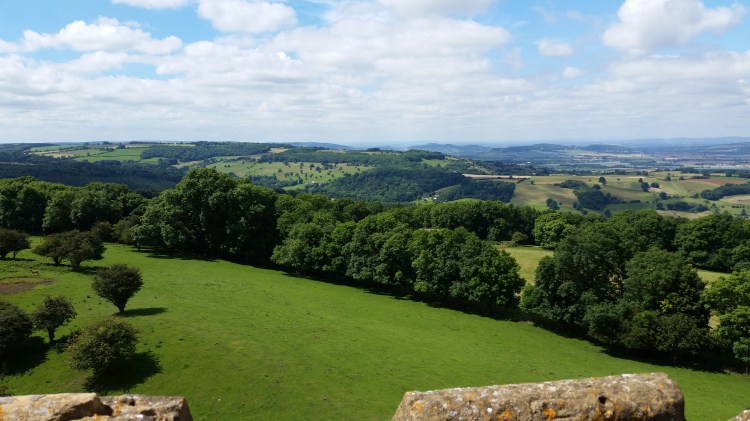
What do you do in a heatwave? We headed for the Cotwolds and one of our favourite places, Broadway Tower.20160718_135655

The last time I was there a cold gusty wind and a heavy damp mist greeted us.

But on this visit, the sun blazed out of an azure sky,20160718_123139


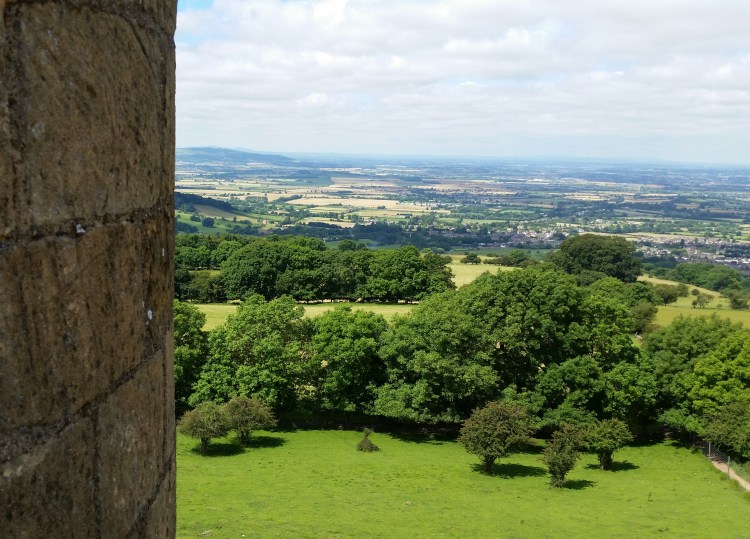
and it was an ideal day to climb the Tower20160718_122645 and view the 16 counties from the top.20160718_122306

I’ve written about Broadway Tower before on this blog as it’s a place of inspiration, 20160718_122253not least because of its association with the preRaphaelites and in particular William Morris, whose philosophy I admire and whose designs I love.20160718_122322-1
As I wrote in my previous post about Broadway Tower, among all things most romantic to me is a high place.

I go to high places for calmness and peace, and also to reconnect with that sense of perspective we all need so dearly in the world today.

There are a number of high places I love to visit, from where I live in Warwickshire. the nearest are the Burton Dasset Hills; Broadway Tower is about half an hour away; and the Malverns a little further.  But all are sources of inspiration.

What are your favourite places to visit, for inspiration and upliftment of spirits?  I’d love to hear about them, wherever you live… unless of course they are secret locations that you don’t want to be swamped by visitors! Do share in the comments below.


Amateur Actors, No Rehearsal, Disorganised Direction, Disappearing Props – A Dream for Shakespeare

This weekend I joined a cast in a drama – at St Mark’s Church in Leamington Spa – which I think Shakespeare would have loved. Why? because we were rather like the little band of local workmen in that Athenian wood in A Midsummer Night’s Dream.

But we were not playing “Pyramus and Thisbe”. Instead, without rehearsal, and with hastily gathered together props, we were ambitiously – and creatively – portraying the entire story of Joseph, (but not with Lloyd Webber music and lyrics).Shakespeare's 'Rude Mechanicals' in A Midsummer Night's Dream

I must admit I’d been wondering how I’d pan out as the Butler/Servant, with my son Jamie as the older Joseph. I was a little concerned beforehand about the large number of props, and the extent to which I’d need to rely on several other actors simultaneously doing the right thing – not to mention a question about whether there was going to be any kind of stage management  i.e. people in charge of making sure microphones and props were in the right hands at the right times.

And it was more fun and more memorable than a slick performance by professionals would have been.

It occurred to me Shakespeare would have loved it. Even his Rude Mechanicals in A Midsummer Night’s Dream couldn’t have bettered  our organised chaos.

For anything that could possibly go wrong in such a set-up, did.

The two narrators doubled up as stage manager and director.

Some of the performers behaved as if they’d only been cast that morning and had never seen the script before.

I was convinced others were working to different scripts than the one I had, and I wondered whether it had been revised since I was given my copy.

The narrators forgot some of their lines thus depriving actors of cues they’d been relying on.

The one hand-held mic was being passed frantically from actor to actor.

A prop (whistle) was given to me as the Servant/Butler, which I was to blow every time Joseph gave the instruction for someone to be arrested or released from jail, to alert the jailer. But then the director whipped it away unexpectedly from me and gave it to Potiphar – who didn’t even know he had to use it and spoke his lines without using it. The director intervened and grabbed the whistle and gave it to him.  Having used it, Potiphar then put it down somewhere where I, the Servant, couldn’t see it. So in the end I was unable to use it. And since my whistle had disappeared, Joseph’s brother Simeon was never let out of jail.

The actor who played the aforesaid jailer wore shorts and a helmet which was too small for him and he looked like an English policeman on holiday in Egypt.

The whole drama was like a test case for what happens when a troop of unrehearsed amateur actors get together  – exactly as Shakespeare envisaged it with his Rude Mechanicals, with Wall and Moonshine and the chink and Bottom deciding he was going to get up after his character had died and tell the audience it was all right, he was alive really.

And all this fired up my imagination as I thought how it was going to feed into my new novel  – my follow-up to A Passionate Spirit – which features a cast of actors filming A Midsummer Night’s Dream in some south east London woods….


New Book About Writing, For Aspiring Writers

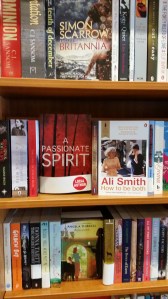
I’m currently working on a new book about writing, which has the working title of Perilous Path: a Writer’s Journey. The book contains 30 short pieces I’ve published online over the past 6 years, both on ezine articles and on this blog, all on the subject of writing a novel.APS on display on shelf in Warwick Books

Here’s a taster from the book. And below the article I’ve posted the current Contents List of the book. I’d love to know if, having read it, you feel you or an aspiring writer you know might be interested in such a book – and whether you would buy it as a paperback or would find it more appealing as an ebook. Over to you, my online audience, for your views and comments!

 Research for novel writing – use the internet


How big a part should the internet play in a novelist’s research? My mind is immediately drawn to a quote from Dan Brown’s novel The Lost Symbol. How often, muses Robert Langdon to himself, has he advised his students that “Google is not a synonym for research”. I couldn’t help laughing at the sly irony of that. For I defy anyone to read this novel without wondering how long the author spent on Google researching his subject matter; and how soon you will get onto Google yourself after reading it, to corroborate his facts – or to fall into the very trap Robert Langdon warns against!

I confess the internet has been a wonderful resource for me as a fiction writer in double-checking my remembered facts. But of course we should never assume whatever we read on the web is necessarily true. It’s important to at least triple-check. But when it comes to writing fiction, I believe most authors will have chosen their subject or theme out of passion – and therefore he or she will have spent a considerable portion of their life researching the subject through multifarious means – personal experience, observing and interacting with people, reading all sorts of printed material about it, visiting places, maybe (but not often) living out some of the things they depict their characters doing…

Therefore the internet is a valuable tool, but cannot serve as the sole source of material when researching a novel.

I may take as an example the Cotswolds location for my first published psychological thriller Mystical Circles. I was inspired by three places. Firstly Totleigh Barton at Sheepwash, near Beauworthy in Devon where I once attended a five day Arvon Foundation poetry course: it boasted a monk’s room, as does the farmhouse in my novel. Also the diverse group of students on the course inspired me for the group dynamics of my story. Secondly my imagination was fired by the Lygon Arms Hotel in Broadway in the Cotswolds, a wonderful setting for a psychological thriller. My favourite piece of research involved afternoon tea there. The manager took us for a tour of some of the historical rooms in the hotel including the Cromwell Room. The owners of the inn were neutral during the English Civil War and thus hosted guests on both sides of the conflict. I used some of the details of the interiors here in my descriptions of the sixteenth century farmhouse. And thirdly, for my setting, although I ultimately chose the Cotswolds as my favoured location, I was also inspired by a farmhouse near the Forest of Orleans in France owned by the eccentric uncle of my then boyfriend. We visited his uncle there several years ago. When I met him, he displayed a love of practical jokes, leaving plastic rats and spiders for me to find in odd corners. He also owned a parrot, which I came upon by surprise in his sitting room, exactly as I describe my main protagonist Julie coming upon the gold and blue macaw in Mystical Circles.

I hope all this will serve to illustrate how every aspect of your life can be regarded as research for your novel. Life itself is one long process of research. Bad experiences and good, failures and humiliations… nothing is wasted, or lost. Surely this is the ultimate recycling! – it is certainly one of the things I most love about fiction writing.

SC Skillman

Contents page of proposed new book: Perilous Path: a Writer’s Journey by SC Skillman

Introduction: The Writer’s Journey: Pursuing your Creative Passion

  1. Research for novel writing – use the internet
  2. What’s creative writing? – tips for new writers
  3. Elements that make up a good fiction story
  4. 3 tips for creative works of realistic fiction
  5. Research and fiction – how to research when something doesn’t exist
  6. Universal themes in fiction
  7. Strategies to develop creative and imaginative writing
  8. How to pick a topic to write creatively about
  9. How to know which point of view to use in a story
  10. 5 tips on how to make your fictional characters engaging
  11. How to create a novel that your readers won’t want to put down
  12. The writing process for creating a novel in less than a month
  13. How to start a novel
  14. How to fictionalise characters
  15. How to develop a character in a novel
  16. How to create layers within each of your characters
  17. How to develop villainous characteristic traits in your writing
  18. The importance of choosing words carefully – your audience’s interpretation matters
  19. Character creation – the most interesting fictional characters of all
  20. How to structure your writing to improve the flow of the story
  21. How to get over writer’s block when halfway through your novel
  22. Good things to do to improve your creative writing
  23. How to successfully write the plot of your novel in reverse
  24. How can Carl Jung’s theory of archetypes help you in your creative writing?
  25. How can Carl Jung’s theory of synchronicity help you in your creative writing?
  26. How can Carl Jung’s theory of The Shadow help you in your creative writing?
  27. Inspiration for creative writers from art
  28. Inspiration for creative writers from music
  29. Suggestions for writing the end of a novel
  30. Learning from Hemingway


How To Start a Novel

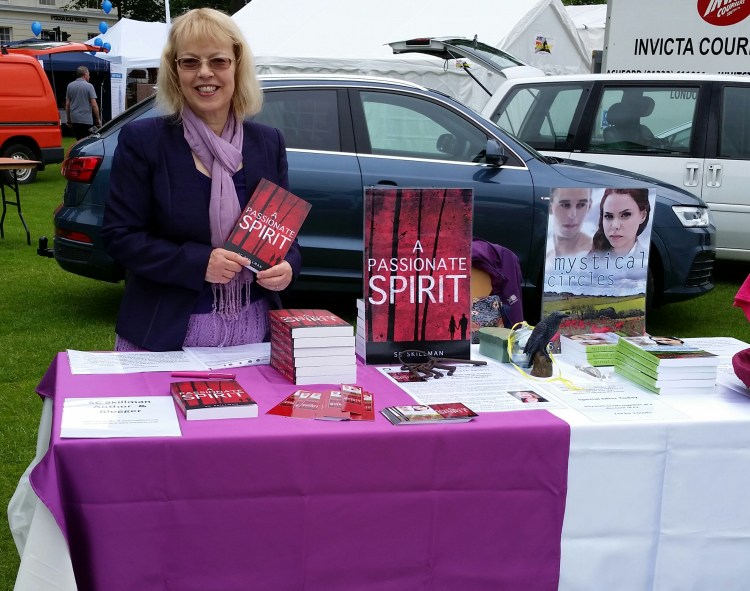
When I was signing books at the Leamington Peace Festival on Saturday 18th June,  a young man came up to my book stall and started chatting to me about writing books; it turned out he was writing a book himself and wanted any advice I could give on the best way to start a book. 20160618_105109-1

My advice was particularly tailored to writing a novel but of course it’s relevant to any book targeted at a commercial audience.

The beginning of a book must have some kind of emotional charge. It has to hook the reader in the first paragraph or first page.  In the case of a novel the best way to start is with a scene of conflict in the life of your main protagonist. This scene needs to show where your MP currently is, in their life, and what the tensions are in their situation.

One of the courses I took a few years ago covered story structure in terms of the 7 point arc.  I remember it mentioned that you begin a story with Stasis – in other words, where the MP is right now.  Then there is an Inciting Event –  in classic story structure of myth and legend, the MP receives a call, which will move him or her out of the ordinary world, into a new world. The MP can either accept this call or reject it. Either way it is the invitation to a quest. There are many ways of illustrating story structure, using different metaphors but The Hero’s Journey is the best to my eyes. It sets out the structure of a story in terms of classic myth or fairy tale format.  And it makes big sense to me.

Many novelists find one of the trickiest things is to know Where to Start Your Story. Finding out that key moment is a great challenge. You may not discover it until you’ve written the whole book. I advised the young man not to worry about it too much but to write the book all the way through first, because inevitably he will go back to the beginning and probably rewrite it several times.  You can often only find out where your story starts, that moment of tension, after you have written the story.

Sometimes the story may start three chapters later than you through it did, and you will need to cut out your first chapters entirely.  Or maybe it starts further back.  Either way, it can be very exciting and revealing, when you find that perfect point where your story starts.

If you’re writing a novel, I welcome any thoughts you would like to add to this subject, in the comments.


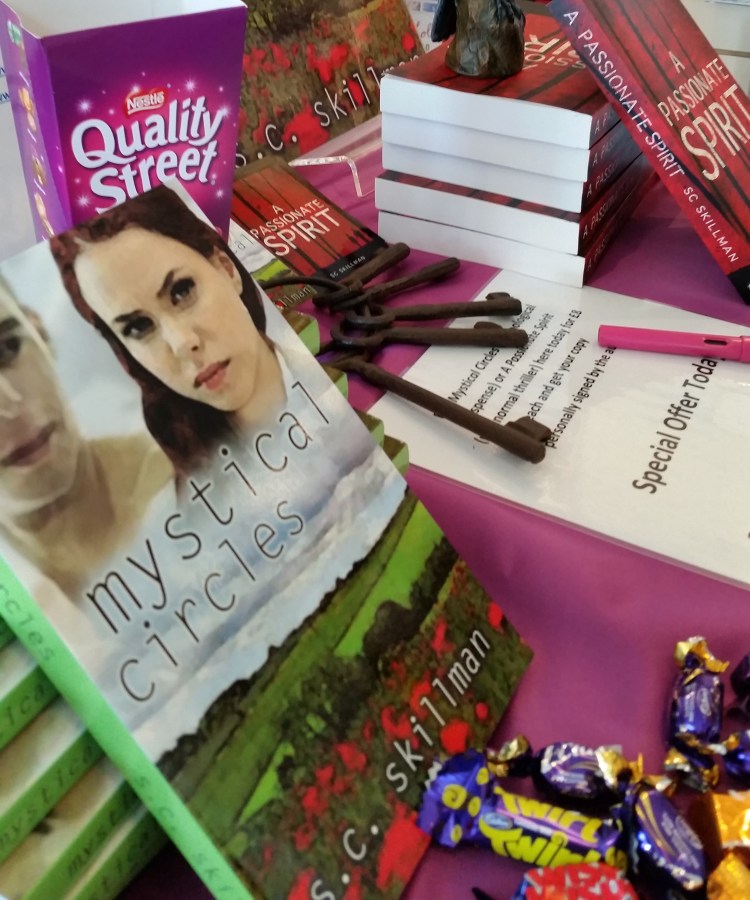
Come and See Me at Costa Coffee in Royal Priors Leamington Spa on Fri 24 June and Buy a Signed Copy of Mystical Circles And A Passionate Spirit

I had a great time at the Leamington Peace Festival over the weekend, and enjoyed chatting to many interesting people at my local author stall.

cropped image of my booksigning tableNot only did I sell some books to keen readers, and meet someone who was uncannily like one of my characters in Mystical Circles, who asked me for advice on how to start his own book, but also had a conversation about the paranormal involving a dog and the council and several fast-disappearing residents from a Birmingham house, which gave me ideas for future use in a novel!20160618_105109-1.jpg

I’d love to see you on Friday 24 June 11am to 2pm in Costa Coffee,  Royal Priors, Leamington Spa, where again I’ll be selling signed copies of both novels. Do drop in if you’re in Leamington that day!


Reflections on Australia: Binna Burra, Rainforest Resort in the Gold Coast Hinterland

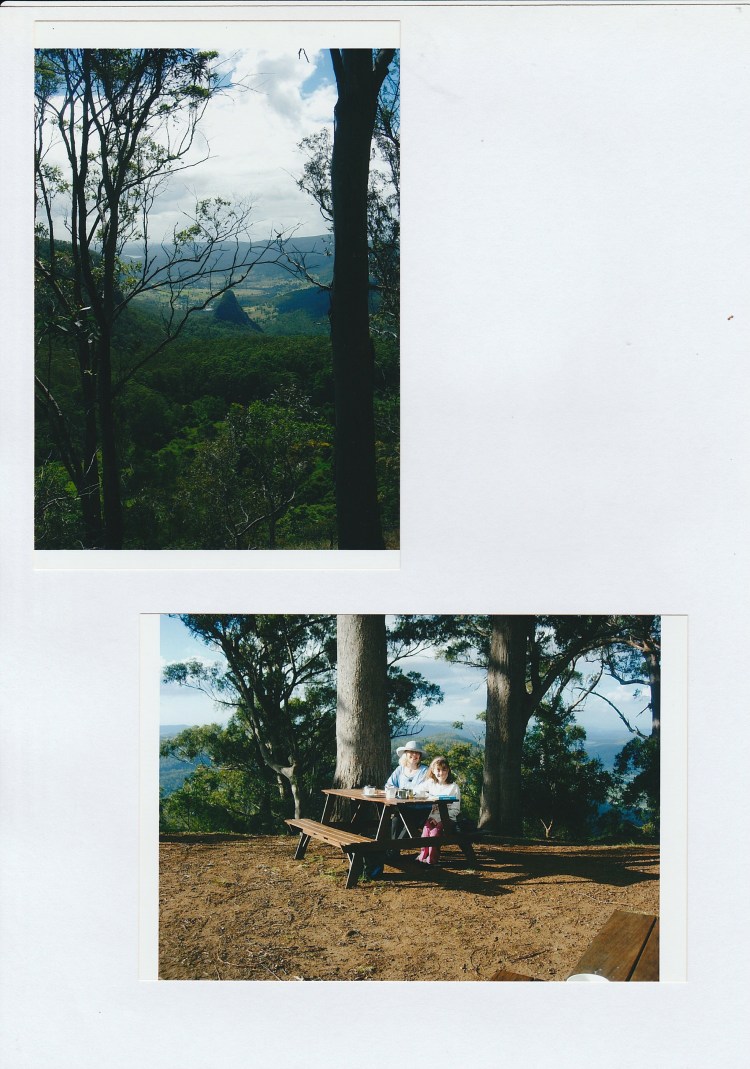
As my daughter Abigail and her friend Gaby have just flown out to Australia to stay with my sister in Brisbane for the next few weeks, I’m thinking of Australia – and of the times I’ve visited that continent, and of the four and a half years I spent living and working there.Binna Burra 2007


I’ve written before about the Gold Coast Hinterland, Queensland in my Places of Inspiration.  series, along with several other locations around the world.  What all these places have in common is spirit of place.

I found this spirit in India, at Uluru in Australia, in London, in the White Garden at Sissinghurst in Kent, and in Sydney Opera House. Today let me show you another part of Australia – Binna Burra.

On the border of Queensland and New South Wales, behind the Gold Coast, you may find a beautiful mountain range. This is known as the Gold Coast hinterland. The road winds up via many mountain passes from Southport, just north of Surfers Paradise. You travel via the town of Canungra where you may choose between two roads, going to two mountain resorts: Binna Burra and O’Reilly’s. I have spent time at both these resorts but here I’m concentrating on Binna Burra.

Binna Burra is special to me. Why is this so?

Binna Burra holds many memories; and it is a very important stage on my spiritual journey. I’ve been up there on my own, and in company with others, and have always found it a very powerful place, full of spiritual resonance. I remember standing there listening to the birdsong echoing across the mountain range, their peaks and valleys hazy with eucalyptus vapour; of waking up early in the morning, stepping outside my cabin, and tasting the mountain air as if it was fine wine.

I remember going on the Coomera Circuit, the longest of the many rainforest walks visitor may take from the lodge, which passes the beautiful Coomera Falls. there was the time we went out on a night time walk to see the luminous fungi, and another time we went to see the glow-worms.

I remember when I went on my own to Binna Burra, and found a table of other single visitors, who were so welcoming and fun and friendly. Then there was the occasion when I visited Australia with my friend Alison and my daughter Abigail and we met up with friends who lived on the Gold Coast, Paul and Mark, and we all went up to Binna Burra and had lunch in the clifftop dining room with its panoramic views of the mountain scenery.

And then of course there’s the wildlife; the possums and rainbow lorikeets and the red-eyed tree-frogs. And of course the snakes that may be lying across your path; and are a good reason to take a torch with you when you walk by night.

Do you have a special place that means a lot to you, a place of inspiration, that you believe you will constantly revisit, or at least remember for the rest of your life? Please share in the comments below!


Wildflower Inspiration from Highgrove

One of the loveliest things about England is the sight of our native wildflowers. wildflower meadow at Highgrove

For some it may be possible to take these things for granted, but to me, cow-parsley growing in the hedgerows, and bluebells appearing in unexpected places, is something miraculous – along with the oxeye daisy, the meadow buttercup, viper’s bugloss, red clover, the cowslip and many others exquisite plants and wild grasses. And so I was delighted to visit the Prince of Wales’ garden to Highgrove again last Wednesday, to see his wildflower meadow in its full glory, and to hear a talk on Plantlife.

I first wrote about Highgrove when I visited the garden last August, and then I noted how quirky, playful and imaginative it is.  However the wildflower meadow had been mown and it wasn’t the time of year to appreciate its true beauty. Now, however, we could delight in it as we learned about orchids and buttercups, about crested dogtail and sweet vernal grass.  Afterwards we enjoyed a glass of Pimm’s on the terrace then went into the Prince’s visitor reception centre the Orchard Room, for a delicious meal and a talk from Plantlife about the Coronation Meadows project, which aims to have created 90 wildflower meadows around the UK by the Queen’s 90th birthday. The talk was highly inspirational and by the end I was determined to create a wildflower meadow in a 4 metre square area of our own garden.

Later I was reading the Prince’s book on Highgrove Garden and I was particularly struck by what he says in his foreword. He wrote about the so-far 36-year process of creating a garden like this from scratch (in 1980 when he bought Highgrove there was nothing but extensive grassland with a few trees). Though he was talking about gardening, many of his words related closely to the creative writing process too:

He spoke of “moments of magic… light becoming dreamlike, illuminating intensity” and in such moments when we are “lost in wonder that such beauty is possible, inspiration can come.” It can “easily go wrong if you rush at it,” he wrote; and he advised against “forcing a plan or design.” Instead he believes we must “wait for an intuitive idea to form itself when the moment is right.” In many cases, he observed, it was “several years before the correct setting dawned on me.” He hoped that visitors, whether garden experts or not, would find something here to “inspire, excite, fascinate or soothe.”

Some may regard this view of the creative process rather high-minded; and of course, perfectionism can create its own problems;  and yet I believe there is much truth in these words, and they can be applied across many creative endeavours.

If you’d like to visit Highgrove take a look here for further details.